
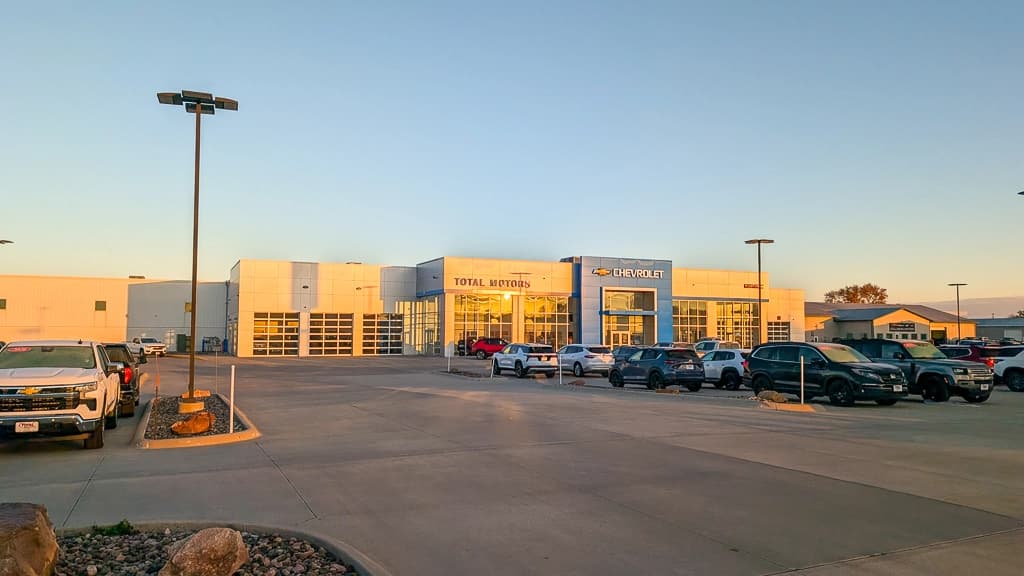
Coleman Automotive dealership in Le Mars, Iowa. Rural franchise stores often dominate their local markets with minimal competitive pressure. Photo: Sweet Dreams US LLC
Dealership Acquisition Strategy: Why Rural and Secondary Markets Are the Smart Money Play
The biggest returns in automotive retail are not in metro showrooms. They are in the towns that Wall Street forgot.
When most investors picture a car dealership worth acquiring, they imagine a gleaming metro showroom on an auto mile — high visibility, high traffic, high price. That image is the reason most investors overpay for dealerships that underperform.
Coleman Automotive Group has built its portfolio with a different thesis: the highest risk-adjusted returns in automotive retail come from franchised dealerships in secondary and rural markets — the communities of 15,000 to 80,000 people where a single dealership often serves an entire county, where the nearest competitor is 45 minutes away, and where customer loyalty is measured in generations, not transactions.
The Economics of Market Dominance
A metro dealership in a competitive market might hold 8% to 12% market share for its brand. A rural franchise store routinely holds 30% to 50% or more. The franchise territory protections that exist in every state are potent in metro markets. In rural markets, they are absolute. When the nearest same-brand competitor is 60 miles away, the franchise agreement does not just limit competition — it eliminates it.
This market dominance translates directly into financial performance. Service retention rates in rural stores regularly exceed 55%, compared to the national average of roughly 34%. Customers in these communities service their vehicles at the dealership because the dealership is the only qualified option. Parts and service gross margins run higher because price competition is minimal. And new vehicle allocation from the manufacturer — which is partially determined by market share performance — remains strong because the store is, by definition, performing at or near the top of its zone.
Acquisition Multiples That Metro Buyers Cannot Access
The most compelling advantage of the rural strategy is purchase price. Metro dealerships in desirable brands routinely trade at 6x to 10x adjusted pretax earnings, with premium import franchises like Toyota and Honda sometimes exceeding 12x. Rural and secondary market stores trade at 3x to 5x — not because they are worse businesses, but because the buyer pool is smaller. Most institutional acquirers and publicly traded groups prefer the scale and visibility of metro acquisitions. They are optimizing for revenue concentration, not return on invested capital.
Coleman Automotive optimizes for the opposite. A store acquired at 3.5x adjusted earnings in a market with 40% service retention and minimal competition offers more operational upside than a store acquired at 8x in a market where five competitors are fighting for the same customer base. The playbook is to acquire at a reasonable multiple, implement operational improvements that the previous family ownership deferred, and harvest the margin expansion that follows.
Community Anchor Businesses and Workforce Stability
Rural dealerships function differently within their communities than metro stores. In a town of 20,000 people, the dealership is often one of the top five employers. The general manager is a member of the Rotary Club. The service advisors coach Little League. The relationship between the store and its customers is personal in a way that metro retail can never replicate, and that personal connection produces measurably lower employee turnover, higher customer satisfaction scores, and stronger repeat purchase rates.
For an investor, workforce stability translates directly into operating margin. Employee turnover in auto retail averages 46% annually at the national level. In Coleman Automotive’s rural stores, turnover runs significantly lower. Every percentage point of reduced turnover eliminates recruiting costs, training costs, and the lost productivity that accompanies a new hire learning the systems. In a business where the service advisor’s relationship with the customer determines whether a repair order is $400 or $900, retention is not a human resources metric. It is a profitability driver.
The Risk Profile Metro Investors Miss
The conventional wisdom is that rural markets carry more risk because the customer base is smaller. The data says otherwise. Rural franchise dealerships have lower failure rates than metro stores, in part because of reduced competition but also because of more conservative cost structures. Land costs are a fraction of metro prices. Construction costs for manufacturer-required facility upgrades are lower. Floor plan exposure is smaller because inventory levels match the market size. The operating leverage that makes metro dealerships fragile in a downturn is muted in rural stores where overhead is calibrated to a stable, loyal customer base.
The Prime Dealer Equity Fund’s co-investment structure was designed specifically for this acquisition profile. By pairing Coleman Automotive’s operational expertise with investor capital, the fund accesses stores in markets that are too small for public consolidators but too valuable to ignore. That gap between institutional interest and asset quality is where the alpha lives.
Prime Dealer Equity Fund is a private equity vehicle co-investing with Coleman Automotive Group in the acquisition and optimization of automotive dealerships across the United States.
For qualified investor inquiries:
→ Contact our investor relations team