
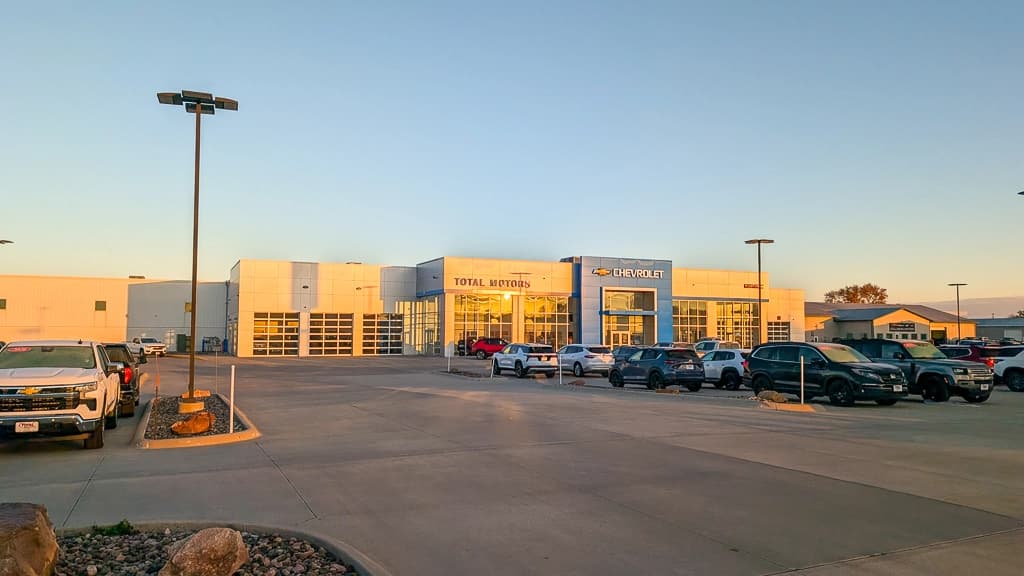
Le Mars dealership, Le Mars, Iowa. Photo: Sweet Dreams US LLC
The EV Transition Will Strengthen — Not Destroy — Franchise Dealership Profitability
Higher repair order values, fewer independent competitors, and a growing service moat.
Every sophisticated investor considering a dealership allocation asks the same question: what happens to service revenue when electric vehicles eliminate oil changes, reduce brake wear, and require less routine maintenance? It is the right question. And the early data provides an answer that surprises most people who ask it.
The electric vehicle transition will not destroy franchise dealership profitability. It will restructure the revenue composition of the service department — and for operators who prepare for it, the restructuring is favorable. The premise that EVs will hollow out fixed operations is based on an incomplete understanding of what drives service department revenue and an underestimation of how the complexity of modern EV platforms creates competitive advantages for franchised dealers.
Higher Repair Order Values
While battery electric vehicles may visit the service department less frequently for routine maintenance — no oil changes, reduced brake pad replacement due to regenerative braking — the average revenue generated per service visit is significantly higher. Some large dealer groups report average EV repair order values in the range of $1,300, compared to approximately $700 for a traditional internal combustion engine vehicle. The difference is driven by the complexity and cost of high-voltage battery diagnostics, thermal management systems, software recalibrations, and accelerated tire wear caused by the additional weight and torque characteristics of electric powertrains.
This shift in economics changes the fundamental calculus. Fewer visits at nearly double the revenue per visit can produce equivalent or superior total service revenue — and the margin profile on complex EV work tends to be higher than on commodity maintenance items like oil changes, where competition from quick-lube chains has historically compressed pricing.
The Independent Shop Barrier
The franchise dealer’s primary competitor in post-warranty service has always been the independent repair shop. For traditional vehicles, independents could invest in relatively affordable diagnostic tools and training to capture a meaningful share of the service market once a vehicle’s factory warranty expired.
Electric vehicles change this dynamic fundamentally. The capital requirements for EV-capable service equipment — specialized lifts rated for the weight of battery packs, high-voltage safety equipment, manufacturer-specific diagnostic software, and the continuous training certifications required for technicians to work safely on high-voltage systems — are prohibitively expensive for most independent operators. The result is that post-warranty EV service is migrating back to the franchise dealer, reversing a decades-long trend of customer attrition to independents.
The Hybrid Reality
It is also worth noting that the vehicle parc is not transitioning to electric overnight. Internal combustion engines will remain the majority of vehicles on the road for decades. The transition will be gradual, and during the transition period, dealerships will service a mixed fleet of ICE, hybrid, and fully electric vehicles. The service department that can handle all three powertrains competently will capture a disproportionate share of the local service market.
For investors evaluating a dealership’s long-term viability, the EV transition is not a threat to be feared. It is a structural shift that favors the franchise dealer over the independent competitor, increases per-visit revenue even as visit frequency declines, and creates a technical barrier to entry that reinforces the franchise’s competitive moat. The operators who invest in EV readiness today will own the service market of the next two decades.
Prime Dealer Equity Fund is a private equity vehicle co-investing with Coleman Automotive Group in the acquisition and optimization of automotive dealerships across the United States.
For qualified investor inquiries:
→ Contact our investor relations team