
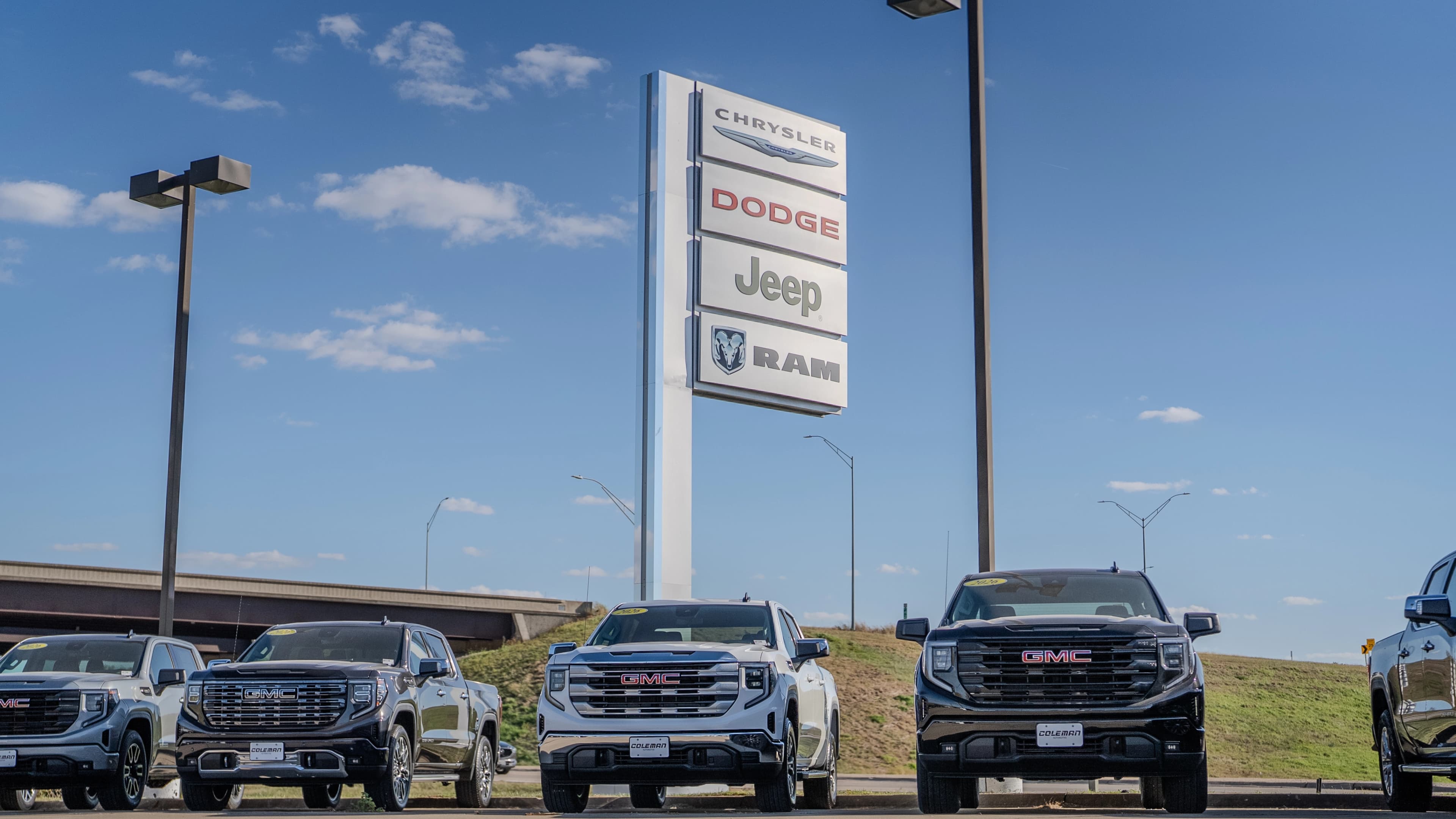
Trucks on the lot at Mt. Pleasant Chevy GMC CDJR, a Coleman Automotive dealership in Iowa. Each used unit on a lot like this started with an appraisal decision. Photo: Sweet Dreams US LLC
Trade-In Appraisal and the Wholesale Market: vAuto, Black Book, and Manheim
In the used-vehicle business, profit is made when a car is bought, not when it is sold. The appraisal lane and the wholesale market are where that profit is won or lost.
The United States sells far more used vehicles than new ones — industry estimates from Cox Automotive and others put annual used-vehicle sales at roughly two to two-and-a-half times new-vehicle volume. For a franchised dealer, the used-vehicle department is one of the largest sources of gross profit and one of the clearest tests of operating skill. It is also the department most exposed to the price swings of the wholesale market, which is why the discipline behind it matters as much as the gross it produces. Unlike new vehicles, where the manufacturer sets the cost and the internet sets the price, used vehicles give the dealer control over both sides of the trade.
That control cuts both ways. A store that buys used vehicles well, reconditions them efficiently, and prices them to the market can earn healthy gross while turning inventory quickly. A store that overpays at acquisition spends the next sixty days trying to recover a mistake it made on the first day. Experienced used car managers have a saying that captures this: you make your money when you buy the car. Every dollar overpaid at appraisal is a dollar the store must either recover from the next customer, in a market where that customer can see every competing listing, or write off when the unit is eventually wholesaled.
This chapter walks through how a dealership appraises a trade-in, the data tools that inform modern appraisals, how the wholesale market works as both a source of inventory and a disposal channel, and what investors should look for when evaluating a store's used-vehicle operation.
Why Trade-Ins Are the Best Source of Used Inventory
Dealers acquire used vehicles from several channels: trade-ins from customers buying another vehicle, vehicles purchased directly from consumers who are not buying, service-lane acquisitions from customers whose vehicles are in for repair, off-lease returns, and purchases at wholesale auctions. Of these, trade-ins have historically been the most attractive. The store acquires the vehicle at or near its wholesale value, with no auction fees or transport costs, and often with a known service history from its own records.
Auction-sourced vehicles, by contrast, are bought in competition with every other dealer bidding on the same unit, with buyer fees and transportation added on top. Auctions are an essential channel for filling specific inventory gaps, but a used department that depends heavily on auction purchases typically starts each unit with a thinner margin than one that sources locally. The difference on a single unit may be modest, but across hundreds of used units a year it compounds into a meaningful gap in departmental gross. That is why many operators track the share of used inventory that is self-sourced — through trades, street purchases, and the service lane — as a core management metric.
The appraisal also shapes the new-vehicle deal. As we showed in our chapter on desking the deal, the trade allowance presented to the customer and the value at which the trade is booked into inventory are two different numbers, and the gap between them flows directly into front-end gross. An accurate appraisal protects both the used department and the new-vehicle deal it supports.
How an Appraisal Is Built
A professional appraisal begins with the vehicle itself: VIN decode to confirm year, make, model, trim, and factory options; a walkaround to assess body condition, paint, glass, and tires; an interior inspection; a test drive; and a review of vehicle history reports for prior accidents, title brands, and ownership history. The appraiser estimates the reconditioning the vehicle will need to be retail-ready — mechanical repairs, tires, brakes, cosmetic work, and detail.
Modern appraisals then work backward from the market. Rather than asking what a guidebook says the car is worth, the appraiser asks what the vehicle is likely to retail for in the store's market, how quickly it is likely to sell, and what the store needs to earn on it. Subtracting the target gross, reconditioning, and any pack from the expected retail price produces the maximum the store can pay — the actual cash value, or ACV, the store is willing to book.
By the Numbers
Illustrative Example: Working an Appraisal Backward from Retail
Expected retail price based on comparable market listings: $30,000
Less target front-end gross: $2,500
Less estimated reconditioning: $1,800 — less internal pack: $500
Maximum actual cash value the store can book: $25,200
If the comparable wholesale value is well below $25,200, the store has room; if it is above, the unit may be a wholesale candidate rather than a retail one
All figures are hypothetical and for explanation only
The Data Behind the Number: vAuto, Black Book, and Market Guides
Used-vehicle pricing has been transformed over the past two decades by inventory management software that pulls live market data. vAuto, part of Cox Automotive, is one of the most widely used of these platforms. Its core idea is that used vehicles should be appraised and priced against the live market: how many comparable vehicles are currently listed within a given radius, at what prices, and how quickly similar units have been selling. Metrics such as price-to-market and market days supply let a manager see, unit by unit, whether a vehicle is priced competitively and whether demand for it is strong or soft.
Valuation guides provide a second reference point. Black Book, long known for wholesale values updated frequently to reflect auction results, is widely used by dealers and lenders. Kelley Blue Book, J.D. Power valuation guides (formerly NADA Guides), and other services publish wholesale, trade-in, and retail values used by dealers, lenders, and consumers. Lenders often reference these guides when determining how much they will advance against a vehicle, which links the appraisal to what the store can ultimately finance. For an investor, the important point is that these tools are widely available to every dealer in a market. The advantage does not come from having the software; it comes from using it consistently, on every unit, with managers who review the results.
No single source is the answer. A disciplined appraiser triangulates: guide values for a baseline, recent auction transactions for what dealers are actually paying, live retail listings for what the vehicle can sell for locally, and the store's own sales history for how that type of vehicle performs on its lot. Where those sources disagree — a guide value well above recent auction results, for example — the appraiser should lean toward the evidence of actual transactions, because that is what the store will face if the vehicle has to be wholesaled later. The tools make the appraiser faster and more consistent; they do not replace judgment about condition, reconditioning, and local demand.

Manheim and the Wholesale Market
Behind the retail used-vehicle market sits a large wholesale market, where dealers, rental companies, lenders, and fleet operators buy and sell vehicles among themselves. Manheim, also part of Cox Automotive, is the largest operator of physical and digital wholesale auctions in the United States. Digital-first platforms such as ACV Auctions and OPENLANE have grown alongside it, allowing dealers to buy and sell vehicles remotely with condition reports, photos, and arbitration policies.
Manheim also publishes the Manheim Used Vehicle Value Index, a widely followed measure of wholesale used-vehicle prices adjusted for mix, mileage, and seasonality. Investors and analysts watch it as a barometer of the used-vehicle market. The index rose dramatically during the 2021–2022 supply shortage and has moderated since. For an operator, the index is context; for a store, what matters is the wholesale value of the specific units on its lot and in its appraisal lane.
The wholesale market plays two roles for a franchised dealer. First, it is a source of inventory when trades and local purchases do not supply the vehicles the store needs. Second, it is the safety valve for vehicles the store should not retail — units that are too old, too high-mileage, the wrong segment for the market, or simply aged beyond the store's turn policy. As we covered in our chapter on days supply and aged inventory, a unit that has sat too long is often worth more to the store as wholesale cash than as a retail hope.
Wholesale Discipline: Knowing When to Let Go
Many well-run stores set an explicit aging policy: a used vehicle that has not sold within a defined window — often somewhere between 45 and 60 days, depending on the store and the market — is wholesaled rather than repriced again. The logic is the same as cutting a losing position. Every additional day costs depreciation and floor plan interest, and the capital tied up in an aged unit could be redeployed into a fresher vehicle with better demand.
Wholesale results are therefore a revealing diagnostic. A store that consistently loses money when it wholesales aged units is often overpaying at appraisal, over-spending on reconditioning, or holding units too long. A store that wholesales trades it chose not to retail at roughly break-even is appraising accurately. Wholesale losses are not inherently bad — some are the price of a disciplined turn policy — but their size and pattern tell you a great deal about the front end of the process.
Reconditioning speed belongs in the same conversation. A vehicle that waits two weeks for inspection, parts, and detail before it is listed is two weeks older on day one of its retail life. Many operators track time-to-line — the days between acquisition and the unit being retail-ready and online — because every day saved there is a day of depreciation and interest the store does not pay.
What Investors Should Look For
When we evaluate a store's used-vehicle operation, we look at the sources of its inventory, the share that is self-sourced, average reconditioning cost and time-to-line, used-vehicle gross per unit after normalizing packs, the age profile of current inventory, and the store's wholesale gains and losses over time. We compare appraisal values to subsequent retail or wholesale outcomes to see whether the appraisal process is calibrated.
We also look at people and process. Who appraises vehicles, and are values reviewed by a manager? Are appraisal photos and notes documented in the system? Does the store actively acquire vehicles from its service customers? A used department built on a few individuals' instincts can perform well, but it is harder to scale and more exposed to turnover than one built on documented process and shared tools.
Prime Insight
Coleman Prime treats the used-vehicle department as a skill business and evaluates it from acquisition forward, not from the sale backward.
In diligence we test appraisal calibration, self-sourcing, reconditioning time and cost, aging discipline, and wholesale results.
After acquisition, Coleman Automotive Group applies consistent market-based appraisal and pricing practices, a defined aging policy, and service-lane acquisition across rooftops.
Prime Dealer Equity Fund is a private equity vehicle co-investing with Coleman Automotive Group in the acquisition and optimization of automotive dealerships across the United States.
For qualified investor inquiries:
→ Contact our investor relations team