
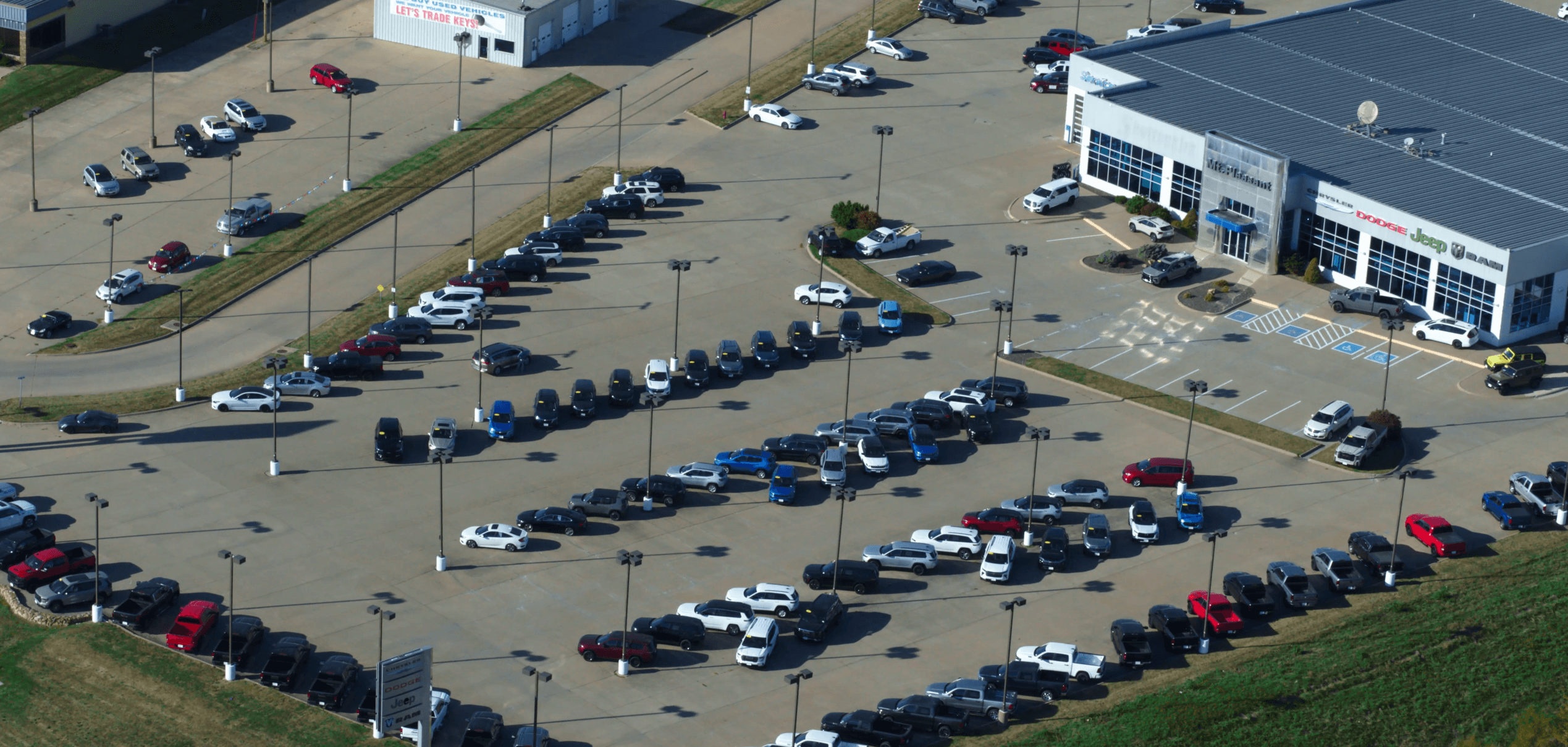
Mt. Pleasant Chevy GMC CDJR, Mt. Pleasant, Iowa. Photo: Sweet Dreams US LLC
Why Car Dealerships Are the Most Overlooked Asset Class in America
Tangible assets, recurring revenue, and a consolidation window that won’t stay open forever.
Most investors have never seriously considered investing in a car dealership. They should.
The average franchised dealership in the United States sits on land it typically owns outright. It operates a parts and service department that generates revenue whether new car sales are booming or collapsing. It holds a franchise agreement that is protected by state law from competitive encroachment and manufacturer termination. And right now, thousands of these businesses are coming to market because the families who built them have no one left to run them.
While private capital has spent the last decade chasing multifamily, self-storage, and triple-net retail, the franchised auto dealership has quietly delivered a combination of tangible real estate security, diversified operational cash flow, and legal protections that none of those asset classes provide. The reason most investors have missed this investment opportunity is simple: dealerships look complicated from the outside. From the inside, the math is remarkably clear.
The Four-Legged Stool: Why a Dealership Isn’t Just a Car Lot
The most common misconception about dealerships is that they make money selling cars. They do — but that is only one of four distinct revenue engines operating under a single roof.
A franchised dealership generates income from new vehicle sales, used vehicle sales, finance and insurance (F&I) products, and fixed operations — the parts, service, and collision departments. Industry professionals call this the "four-legged stool," and it is the structural reason dealerships survive recessions that wipe out single-revenue retail businesses.
When new vehicle margins compress — whether from manufacturer overproduction, rising interest rates, or consumer pullback — used vehicle sales and F&I typically expand. When the broader economy contracts and consumers stop buying altogether, the service department surges because people are forced to maintain the vehicles they already own instead of replacing them. The stool doesn’t tip because when one leg shortens, another extends.
This is not theory. During the 2008 financial crisis, new light-vehicle sales in the U.S. fell from 16.1 million units to 10.4 million — a roughly 35% collapse. In virtually any other retail category, that kind of volume decline would mean insolvency. Yet the average franchised dealership maintained a positive net pretax profit every single year of the recession. By 2009, even as total sales dollars continued to fall, gross margins actually expanded to 15.2% as service and parts revenue filled the gap. The industry calls this phenomenon "fixed absorption" — the ability of the service department alone to cover the dealership’s entire fixed overhead. A dealership with strong fixed absorption doesn’t just survive a downturn. It operates through one.
By the Numbers
2008 Financial Crisis — Average Franchised Dealership
New vehicle sales volume: -35%
Gross margin: Expanded from 13.6% to 15.2%
Net pretax profit: Positive every year of the crisis

The post-pandemic period added another chapter. During the 2022–2023 inventory shortage, per-unit gross profits hit historic highs. As the market normalized through 2024 and 2025, per-unit profitability settled — but it settled at a level roughly 22% above pre-COVID baselines. The floor moved up, and it has stayed up.
How Dealerships Compare to Traditional Real Estate
Investors who allocate to multifamily housing, self-storage, or triple-net pharmacy typically evaluate assets on capitalization rate and operating margin. Dealerships operate on a different valuation framework — one that combines real estate fundamentals with operational business value — and the result is an aggregate yield that outpaces traditional passive investments.
Self-storage cap rates have risen from roughly 5.0% in late 2022 to approximately 5.9% by mid-2024. Prime multifamily trades in the 5% to 6% range. Triple-net pharmacy assets like Walgreens and CVS sit between 6.7% and 7.5%, with increasing credit risk after the Rite Aid bankruptcy signaled that even anchor pharmacy tenants are not bulletproof.
A dealership acquisition splits into two components: the real estate and the "Blue Sky" — the intangible business value of the franchise, its customer base, and its cash flow. The real estate component typically trades at cap rates comparable to commercial retail, between 6.0% and 7.5%. But the operational business, valued as a multiple of adjusted pretax earnings, produces yields in the 12% to 15% range for well-run stores. Combined, the blended return profile significantly exceeds what passive real estate delivers — and it comes with a tenant that operates four distinct profit centers instead of one.
Prime Insight
Prime Dealer Equity Fund structures every co-investment in a dealership acquisition to capture both sides of the value equation — the real estate as a stable, tangible base and the operational cash flow as the return accelerator.
The Fund will hold preferred equity as its minority ownership interest in an acquisition entity with priority capital return before any distributions to the majority owner (Coleman Auto).
The operational complexity that keeps most investors away is precisely what protects the returns. A self-storage facility can be replicated with enough capital and a vacant parcel. A dealership cannot. The franchise agreement, manufacturer approval process, and state-mandated territorial protections create a barrier to entry that prevents the cap rate compression plaguing easier asset classes. Capital is chasing multifamily. Capital is scrutinizing auto retail. That scrutiny is the moat.
The Legal Moat Most Investors Don’t Know Exists
Every state in the country has franchise laws that protect dealerships from their own manufacturers. These laws were originally designed to prevent automakers from unfairly terminating local dealers or opening competing stores. Over decades, they have evolved into one of the most robust regulatory shields in American commerce.
The most significant protection is territorial exclusivity. Most states prohibit a manufacturer from opening a new franchise or a company-owned store within the "Relevant Market Area" of an existing dealer — typically a radius of 10 to 30 miles. This effectively grants the dealership a localized monopoly on new vehicle sales and branded parts for that manufacturer. Research suggests these protections increase per-vehicle margin by $220 to $500 by eliminating intra-brand price competition within the territory.
Termination protections add another layer. A manufacturer cannot simply revoke a franchise because a store is underperforming. State law requires "good cause" — a standard that is notoriously difficult to meet — and even when termination is pursued, the manufacturer is typically required to buy back all unsold inventory, parts, and equipment. The franchise, for all practical purposes, is a perpetual asset.
For the investor, this means the dealership is structurally insulated from the two most common threats in retail: a competitor opening next door and a landlord-tenant relationship that can be terminated. No other asset class in the portfolio offers both.
From the Floor
“People ask why we’re so focused on franchised dealerships specifically. The answer is the franchise law. You’re buying into a legal structure that protects your territory, protects your agreement, and protects your revenue. Try finding that in multifamily.”
— Kyle Coleman, CEO
→ Meet the Coleman Automotive leadership teamThe Generational Transfer: Why the Window Is Open Now
The American dealership landscape is dominated by family-owned operations — many of them founded in the 1950s, 60s, and 70s. The owners who built these businesses are now in their 70s and 80s, and the next generation is, in increasing numbers, choosing not to take over.
The reasons are straightforward. Running a dealership requires intense capital commitment, long hours, constant manufacturer compliance, and deep operational knowledge. Many heirs prefer the liquidity of a sale to the decades of operational burden their parents endured. The result is a surge of high-quality, cash-flowing assets hitting the market at a pace never seen before.
The data is sharp. The number of dealers actively planning to sell has increased 258% since 2022. In 2024, the buy-sell market recorded 438 completed transactions — a 10% increase over the previous record set in 2023. This level of transaction volume during a period of macroeconomic uncertainty signals that both sellers and buyers recognize the structural value of the asset.
For institutional acquirers and private equity funds, this is the entry point. The assets are available. The sellers are motivated. And the operational playbooks to optimize these stores — particularly the underperforming ones that families stopped investing in years ago — are proven and repeatable.
The largest private dealership groups already understand this. In 2024, the top private consolidators accounted for 28% of all franchise acquisitions — the highest share on record. The fragmented, family-owned landscape is professionalizing rapidly. The question for investors is not whether consolidation will happen, but whether they will participate in it.
The EV Question — and Why It’s the Wrong One
Every sophisticated investor asks the same question: what happens to dealership profitability when electric vehicles take over the service department?
The early data answers it clearly. While EVs may require fewer routine maintenance visits — no oil changes, fewer brake replacements due to regenerative braking — the average repair order value for a battery electric vehicle is significantly higher than for an internal combustion engine vehicle. Some large dealer groups report average EV repair orders in the range of $1,300, compared to roughly $700 for a traditional vehicle. The complexity of high-voltage battery systems, software programming, thermal management, and accelerated tire wear from the added weight and torque of EVs drives higher per-visit revenue.
Additionally, that same complexity acts as a moat for the franchised dealer. Independent repair shops — historically the dealership’s primary competitor in post-warranty service — lack the capital to invest in the specialized tools, software licenses, and technician certifications required for modern EV service. The franchise dealer becomes the only viable option for an increasing share of the vehicle parc, improving post-warranty service retention rather than eroding it.
The EV transition does not destroy the dealership model. It restructures the revenue composition of the service department — and for the operator who is prepared for it, it strengthens the competitive position.
Why Now
The automotive dealership asset class sits at a convergence that does not repeat. Record transaction volume proves the liquidity is there. A 258% increase in sellers actively seeking exits ensures the pipeline. State franchise laws provide a regulatory moat that no other retail asset can claim. The four-legged revenue model delivers recession resistance that passive real estate cannot replicate. And the generational transfer window — the moment when decades of family-built value becomes available to institutional operators — is open right now.
It will not stay open indefinitely. The consolidators are already moving. The families are already selling. The only variable is whether the capital that recognizes this opportunity arrives in time to participate on favorable terms.
The smartest investment in America might not be on Wall Street. It might be on Main Street — behind the franchise sign, inside the service bay, and sitting on land that the dealership owns outright.
Prime Dealer Equity Fund is a private equity vehicle co-investing with Coleman Automotive Group in the acquisition and optimization of automotive dealerships across the United States.
For qualified investor inquiries:
→ Contact our investor relations team