

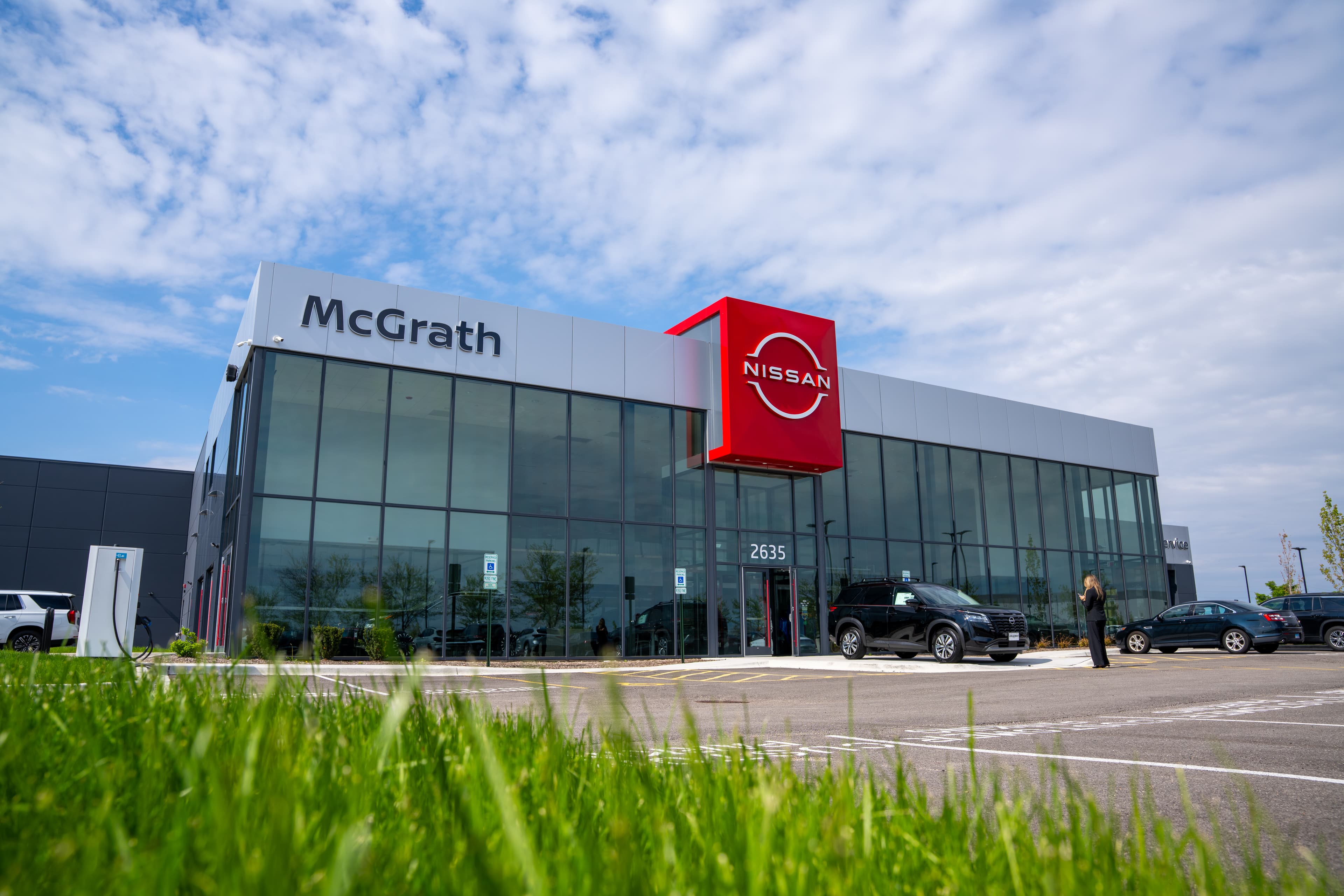
Showroom floor at Nissan of Warsaw, a Coleman Automotive dealership. Every vehicle on this floor is waiting on a process, not a personality. Photo: Sweet Dreams US LLC
The Modern Road to the Sale: Inside the Dealership Sales Process
The showroom sales process is the front door to half of a dealership's revenue. Understanding how it actually works — step by step — is how an investor tells a disciplined store from a lucky one.
Module 1 of this series built the financial skeleton of a dealership: the seven profit centers, the NADA-style financial statement, floor plan, inventory turn, the OEM relationship, and the regulatory perimeter. Module 2 moves to the front of the house — the variable operations side of the business, where new and used vehicles are actually sold. Variable operations typically produce the majority of a dealership's revenue and a large share of its gross profit, and they are where the day-to-day quality of management shows up first.
From the outside, a car sale looks like a single event: a customer walks in, haggles, and drives out. Inside a well-run store, it is a process with defined steps, defined handoffs, and conversion rates measured at every stage. The difference matters to an investor because a sale that depends on one talented salesperson is a key-person risk, while a sale that depends on a process is a scalable asset. When we underwrite an acquisition, we are less interested in last year's unit count than in whether the store has a road to the sale it can repeat.
This chapter walks through the traditional steps of the dealership sales process, how the modern customer has compressed and reordered them, the metrics that tell you whether the process is working, and how pay plans and management structure shape the behavior on the floor.
The Classic Road to the Sale
For decades, the industry has taught some version of a stepwise sales process, often called the road to the sale. The names vary by trainer and by store, but the sequence is broadly consistent: the meet and greet, needs assessment, vehicle selection, product presentation and walkaround, the demonstration drive, the trade-in evaluation, the write-up and negotiation, the turnover to F&I, and finally delivery and follow-up.
Each step exists for an economic reason. The needs assessment is there because selling the wrong vehicle — too expensive, wrong body style, wrong drivetrain for an Iowa winter — creates a deal that falls apart at the desk or comes back as an unhappy customer. The walkaround and test drive exist because customers who drive the vehicle close at materially higher rates than those who do not. The trade evaluation exists because most buyers have a vehicle to dispose of, and that vehicle is often the most profitable piece of the transaction, as we will explore in our chapter on trade-in appraisal. The steps also create checkpoints. A sales manager who knows that a customer has completed a needs assessment and a test drive but has not yet seen numbers can make a very different decision than one who only knows that "someone is on the lot." Process is what turns sales management from guesswork into coaching.
How the Modern Customer Rewrote the Steps
The road to the sale was designed for a customer who arrived knowing relatively little. That customer is largely gone. Cox Automotive's long-running Car Buyer Journey research has consistently found that buyers spend the majority of their shopping time online before they ever contact a store, and that most visit only a small number of dealerships — often just one or two — before buying. By the time a customer walks in, they have frequently already chosen the model, compared prices across several stores, and estimated the value of their trade.
That changes the job. The meet and greet is often a confirmation of an appointment rather than a cold introduction. Needs assessment becomes validation: confirming the trim, color, and options the customer already researched and catching the cases where the online choice does not fit their actual use. Product presentation shifts from features the customer has never heard of to the questions the internet could not answer — how the seat feels, how the infotainment actually works, what the service experience will be.
What has not changed is that most buyers still want to see and drive the vehicle, and most still finish the transaction in person. Industry research has repeatedly shown that while buyers want to complete more of the process online, only a minority want to buy entirely without visiting a store. The modern process is therefore a hybrid: fewer steps performed from scratch, more steps performed to confirm, and a much lower tolerance for wasted time. We return to this in depth in our chapter on digital retailing.
The Metrics That Tell You Whether the Process Works
An investor does not need to stand on the showroom floor to evaluate a sales process. The process leaves fingerprints in the data. The most basic is the closing ratio — the share of showroom opportunities, or "ups," that turn into sold units. A store that logs 400 fresh ups in a month and delivers 80 units is closing at 20%. The same store closing at 25% would deliver 100 units from identical traffic, with no additional advertising spend. That gap is pure process.
Closing ratio is only meaningful when traffic is logged honestly, which is why we look at the CRM before we look at the ratio. A store where salespeople log only the customers who buy will show an implausibly high closing rate and tell you nothing. A store with disciplined up-logging lets you break conversion down by step: what share of customers took a test drive, what share received a written proposal, what share of proposals closed, and what share of unsold customers received follow-up within a day.
The second family of metrics is productivity. Units per salesperson per month is the headline number; industry trainers commonly cite something in the low teens as a solid benchmark for a full-time salesperson, though the right number varies by brand, market, and pay plan. Gross per unit, which we cover in the next chapter, tells you whether those units are being sold well. And the mix of units — how many came from walk-in traffic, internet leads, phone leads, repeat customers, and referrals — tells you how dependent the store is on paid advertising versus its own customer base.
By the Numbers
Illustrative Example: What a Five-Point Closing Improvement Is Worth
Monthly showroom opportunities logged: 400 (illustrative)
Closing ratio at 20%: 80 units per month — at 25%: 100 units per month
Incremental units: 20 per month, or 240 per year, from the same traffic
At an illustrative $3,000 of combined front-end and back-end gross per unit: roughly $720,000 of additional annual gross
Incremental advertising spend required: none — the gain comes from process, training, and follow-up
Who Does What: Salespeople, Managers, and the Desk
The sales floor has a hierarchy that most outsiders never see. Salespeople — often called sales consultants or product specialists — own the customer through presentation and test drive. Sales managers, sometimes working from a central "desk," structure the numbers, approve pricing, and decide when to bring in a second voice. A general sales manager oversees new and used vehicles together, sets pricing strategy, and manages inventory with the used car manager. Above them, the general manager is accountable for the store's total profitability.
One traditional practice that illustrates the structure is the turnover, or T.O. — the moment a salesperson brings a manager into the conversation, either to resolve an objection or to present numbers with more authority. Done well, a turnover is a service to the customer: a decision-maker in the room shortens the transaction. Done badly, it is the source of the endless back-and-forth that customers consistently rank among the least pleasant parts of buying a car. Modern stores increasingly empower salespeople to present a complete, manager-approved proposal on the first pass, which reduces turnovers and shortens time in the store.
Once the customer agrees to terms, the deal is turned over to the F&I office, where financing is finalized, required disclosures are executed, and optional protection products are presented. We covered F&I as a profit center in an earlier post and devote a full module to it later in this series. The key point for the sales process is that the handoff must be clean: a customer who arrives in F&I frustrated by a long negotiation is a customer who will be less receptive and less satisfied, and that shows up in both gross and CSI.
Pay Plans Shape Behavior
Every sales process is ultimately enforced — or undermined — by the pay plan. The traditional structure pays salespeople a commission on front-end gross profit, commonly somewhere in the range of 20% to 30%, with a minimum flat "mini" commission on deals that produce little or no gross. Many plans layer on unit-volume bonuses, CSI bonuses, and spiffs on specific vehicles or products.
Each element pulls behavior in a direction. A plan heavily weighted to gross encourages salespeople to hold price, which can protect margin but slow the turn. A plan heavily weighted to volume encourages speed, which can help aged inventory move but erode gross. A plan with meaningful CSI components encourages the follow-up and delivery quality that drive repeat business. Some stores have moved to salaried or unit-based "one-price" models where the salesperson does not negotiate at all. None of these is right in every market; what matters is that the pay plan and the process point the same direction. In diligence, we read the pay plans alongside the deal log. If the plan rewards something the process is not supposed to do, the deal log usually shows it — in clusters of mini deals at month-end, in unusual gross variance between salespeople, or in follow-up activity that collapses once a customer leaves without buying.
Delivery and Follow-Up: The Step That Pays Later
The last step of the road to the sale is the one most often rushed. A proper delivery means the vehicle is clean and fueled, the customer's phone is paired, key features are explained, and the customer is introduced to the service department before they leave. That final introduction matters more than it seems. As we discussed in our chapters on fixed operations, the service relationship is where a dealership earns recurring, recession-resistant gross — and the sales department is the funnel that fills the service drive.
Follow-up closes the loop. A thank-you call, a check-in after the first week, a reminder before the first service visit, and an annual touch create the repeat and referral business that lowers the store's cost of acquiring the next customer. Stores that sell a meaningful share of units to prior customers and referrals are structurally less dependent on paid advertising, which is one of the quieter signals of a durable franchise.
The road to the sale is not glamorous, and in the age of online research it is shorter than it used to be. But every step still exists for a reason, and every step still leaves a trail in the data. An investor who learns to read that trail can tell the difference between a store that sells cars and a store that has a system for selling cars.
Prime Insight
Coleman Prime evaluates the sales process through the CRM and the deal log, not the sales pitch.
In diligence we test up-logging discipline, step-by-step conversion, follow-up activity, and the alignment between pay plans and desired behavior.
Post-acquisition, Coleman Automotive Group standardizes the process, the CRM workflow, and manager coaching cadence across rooftops while respecting local market differences.
The goal is a sale that depends on a system — which is what makes a store scalable and reduces key-person risk for the Fund.
Prime Dealer Equity Fund is a private equity vehicle co-investing with Coleman Automotive Group in the acquisition and optimization of automotive dealerships across the United States.
For qualified investor inquiries:
→ Contact our investor relations team