
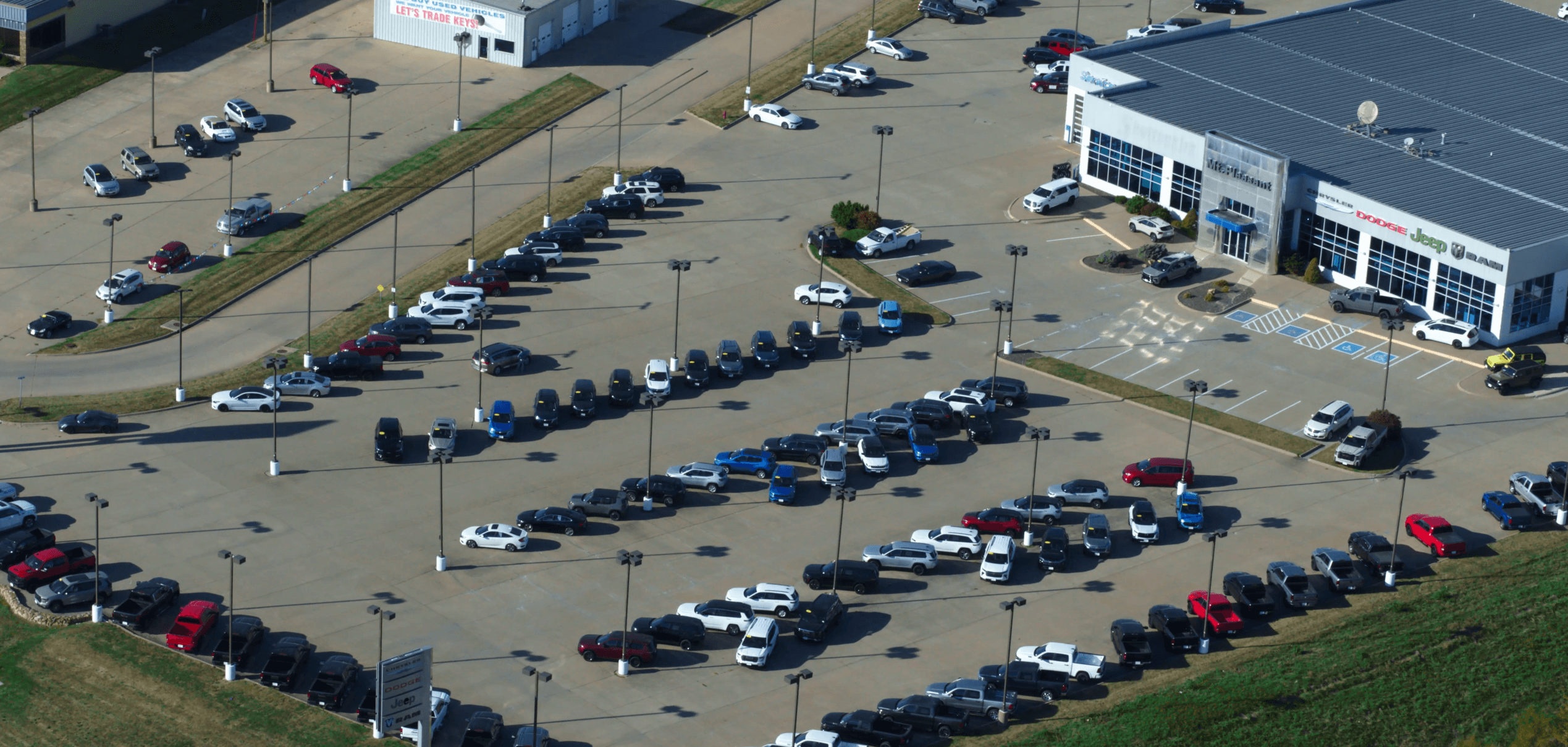
Mt. Pleasant Chevy GMC CDJR — a single rooftop operating seven distinct profit centers. Photo: Sweet Dreams US LLC
Anatomy of a Dealership: The Seven Profit Centers Most Investors Don’t See
New, used, F&I, service, parts, body shop, fleet — the seven independent income streams that make a franchise dealership a portfolio of businesses, not a single retail operation.
When investors first underwrite a dealership, almost all of them build the same model: revenue per new vehicle sold, multiplied by units, minus a gross margin assumption. They treat the store like a single retail business — a car version of a furniture showroom. That mental model is wrong, and it consistently understates both the earnings power and the resilience of the asset.
A modern franchise dealership is not one business. It is seven. Each profit center has its own customer base, its own pricing dynamics, its own demand cycle, and in many cases its own balance sheet treatment. They share a roof, a brand, and a general manager — and almost nothing else. Understanding that structure is the difference between thinking of a dealership as a cyclical retailer and recognizing it as a diversified operating platform.
This chapter walks through the seven streams, why they exist as a bundle, how each one behaves through a cycle, and where the profit actually lands when you open the books. The numbers tend to surprise people — including investors who thought they already knew the industry.
The Seven Streams Explained
New vehicle sales is the headline. It is the most visible profit center, the one consumers experience, and the one analysts track. It is also, on a gross-margin basis, one of the smallest. NADA composite data has shown new-vehicle gross as a share of total store gross drifting in the 25–30% range across most of the last decade, and even lower in normalized markets. New-vehicle volume drives the brand and the door swings, but it does not drive the bottom line.
Used vehicle sales is a separate business that happens to live under the same roof. Used inventory is sourced from trade-ins, off-lease returns, auctions, and direct buys; pricing is set by an entirely different market; and the customer is often a different demographic than the new-vehicle buyer. A well-run used desk operates with its own buyer, its own reconditioning workflow, and its own turn metrics. In a tight new-vehicle supply environment, used quietly becomes the largest single contributor to variable gross.
F&I — finance and insurance — is the third stream, and it is the one most investors miss entirely. When a customer signs paperwork, the dealer earns income on the financing arrangement, on extended service contracts, on GAP coverage, on tire-and-wheel protection, and on a handful of other ancillary products. F&I gross per retail unit at well-run stores routinely runs $1,800–$2,500 and at top performers above $3,000. It is high margin, repeatable, and almost entirely uncorrelated with the price of the underlying vehicle.
Service, Parts, Body, and Fleet
The service department is where the durable economics live. Customer-pay repairs, manufacturer warranty work, and internal reconditioning all flow through the same shop, but they are billed and paid by three different counterparties. Labor rates are set by the dealer, parts margins are set by the dealer, and the customer base compounds with every vehicle sold into the market over the prior decade. Service is the profit center that makes a dealership a recurring-revenue business rather than a transactional one.
Parts is structurally tied to service but operates as its own department with its own P&L. Beyond the parts consumed in the service drive, dealers run wholesale parts operations selling to independent repair shops, run counter sales to retail customers, and increasingly run e-commerce channels for OEM parts. A strong parts manager can build a wholesale book that is meaningful in its own right — particularly for truck and commercial-heavy franchises.
Body shop, where the rooftop has one, is a fifth distinct business. Collision work is paid almost entirely by insurance carriers, runs on direct-repair-program relationships, and has a demand curve driven by accident frequency rather than vehicle sales. Fleet and commercial sales is the seventh — a B2B sales motion serving municipalities, contractors, and corporate accounts, with longer cycles, larger ticket sizes, and recurring service relationships attached to every unit sold.
By the Numbers
The Seven Profit Centers
1. New vehicle sales — franchise-protected, cyclical, brand-driving
2. Used vehicle sales — independent market, supply-driven margins
3. F&I — finance reserve, service contracts, ancillary products
4. Service — customer-pay, warranty, internal reconditioning
5. Parts — counter, wholesale, e-commerce beyond the service drive
6. Body shop / collision — insurance-paid, accident-frequency demand
7. Fleet & commercial — B2B sales with recurring service attached
Why This Diversification Is Structural, Not Strategic
What matters for an investor is that this diversification is not a strategy choice. It is baked into the franchise itself. The OEM agreement requires the dealer to operate a service department, stock parts to a defined level, and meet sales objectives across new and certified used. Customers who buy a vehicle become service customers by virtue of warranty obligations and proximity. Trade-ins create used inventory whether the dealer wants it or not. Insurance carriers route collision work to franchised body shops because of OEM-certified repair requirements.
A general manager cannot decide to “focus on new cars and skip service” the way a retailer can decide to skip a product line. The bundle is the business. That structural cohesion is what makes the dealership model so hard to disrupt — and so durable across operators and across cycles.
It is also what creates the natural diversification that investors pay a premium for in other asset classes. A dealership owner does not need to assemble a portfolio of unrelated businesses to get diversification. The portfolio comes pre-assembled, with shared overhead and a single management team, inside one franchise agreement.
How Each Stream Behaves Differently in a Downturn
The seven streams do not move together. New-vehicle volume is the most cyclical — it falls first and falls hardest in a recession, and historically has dropped 20–30% peak-to-trough in severe downturns. Used vehicle demand often holds steady or even strengthens, because consumers trade down rather than out of the market entirely. F&I follows transaction count, so it softens with new and used volume but remains profitable per unit.
Service, parts, and body shop behave very differently. The installed base of vehicles in operation does not shrink in a recession; it ages. Owners defer trade-ins, drive their existing vehicles longer, and spend more on maintenance and repair to keep them running. Service hours and parts revenue often hold flat or grow during the same quarters new-vehicle gross is collapsing. Body shop demand is tied to miles driven and accident rates, both of which are largely independent of macro conditions.
Fleet and commercial moves on its own clock entirely, driven by municipal budget cycles and corporate replacement schedules that are typically planned years in advance. The result, when you stack the streams, is a composite earnings profile dramatically less volatile than any single line implies — which is precisely why dealership earnings have historically held up better through recessions than the new-vehicle SAAR would suggest.
The Math: Where Profit Actually Comes From
Here is where the model most investors build falls apart. NADA composite reporting consistently shows that fixed operations — service and parts — contribute roughly 45–50% of total store gross profit at a typical franchise dealership, despite generating a much smaller share of revenue. F&I generally contributes another 20–25% of gross. New and used vehicle sales combined often account for less than a third of total gross, even though they represent the overwhelming majority of revenue.
Translate that into the real economics: the “car business” is not primarily a car-selling business. It is a service, parts, and finance business with a vehicle-sales front end that generates the customers and the inventory the back end monetizes. A dealer can lose money on the metal — and many do, on individual deals — and still produce strong store-level returns if the F&I desk and the service drive are running well.
This is the single most important fact for an outside investor to internalize. The headline-grabbing volatility of new-vehicle pricing, OEM incentives, and dealer cash margins is real, but it sits on top of a much larger and much steadier base of gross profit that almost no one outside the industry sees on a P&L.
Why This Matters for the Investor
When Coleman Prime underwrites a dealership, we are not buying a car store. We are buying seven businesses bundled inside one franchise, with seven independent revenue lines, seven different cycle dynamics, and a combined gross profit pool that is far more diversified than any single retail business of comparable size. That is the asset. The vehicle on the showroom floor is the marketing for it.
It is also why operator quality matters so much. Each of the seven profit centers can be run well or run poorly, and the gap between a top-quartile and bottom-quartile operator on the same rooftop is enormous — particularly in F&I and fixed operations, where small process differences compound into hundreds of basis points of store-level return. Buying the right rooftop is half the job. Operating it well is the other half.
For an investor evaluating the asset class, the practical takeaway is to stop modeling dealerships like single-line retailers. Build the model the way the business actually runs — seven streams, seven margin profiles, seven cycle behaviors — and the underwriting case for franchised auto retail starts to look very different from the one most outsiders carry around in their heads.
Prime Insight
Coleman Prime is built around this seven-stream reality. We acquire franchised rooftops with strong fixed operations and underwritten F&I capacity, then deploy Coleman Automotive Group’s operating playbook across all seven profit centers — not just the showroom.
Investors co-invest alongside an operator who runs the bundle as a portfolio, not a single retail business. That is what makes the return profile look more like a diversified operating platform than a cyclical car dealer.
Prime Dealer Equity Fund is a private equity vehicle co-investing with Coleman Automotive Group in the acquisition and optimization of automotive dealerships across the United States.
For qualified investor inquiries:
→ Contact our investor relations team