
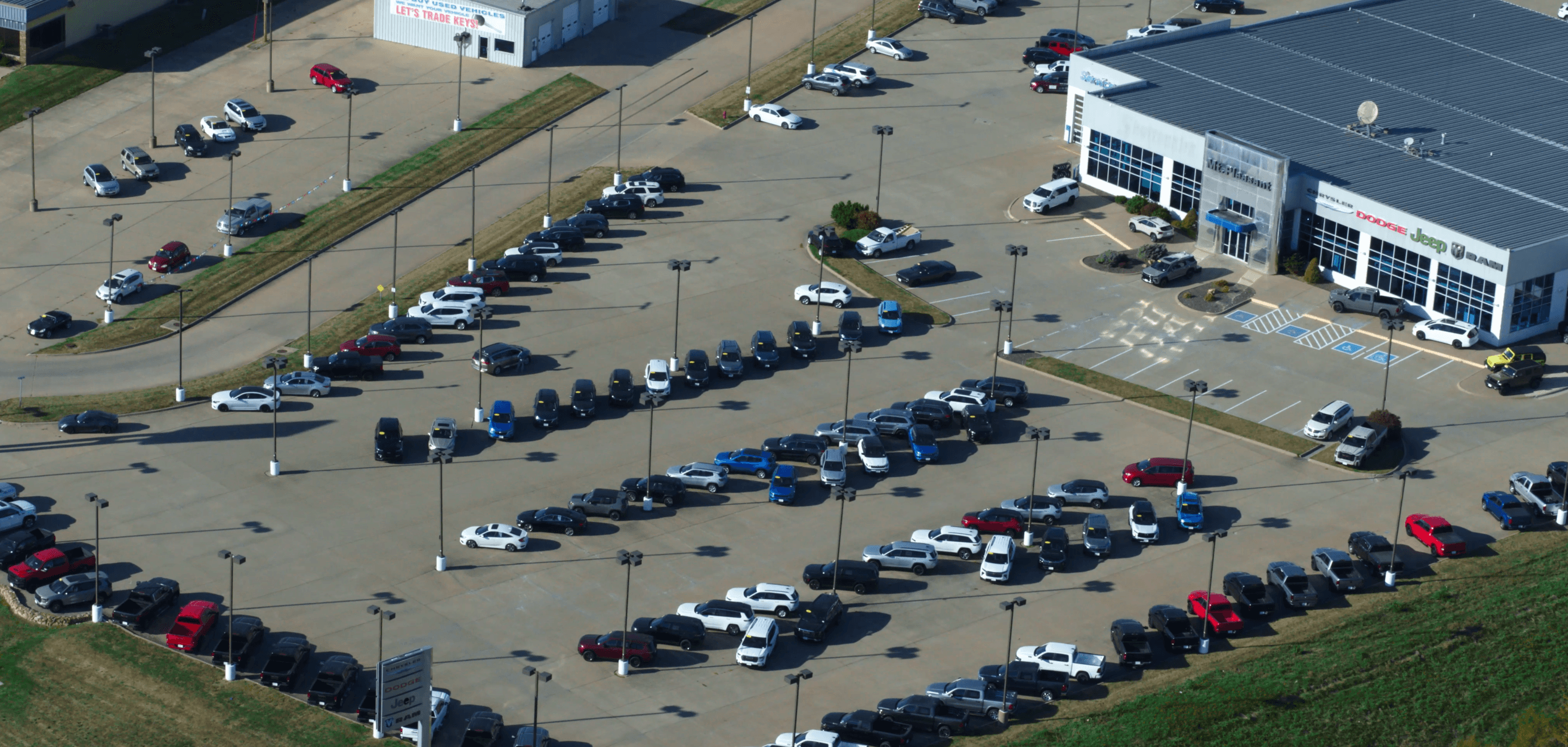
Aerial view of Mt. Pleasant Chevy GMC CDJR in Iowa, a Coleman Automotive dealership. The land, the building, the inventory on the lot, and the franchise itself are often financed by different sources of capital. Photo: Sweet Dreams US LLC
Senior Debt, Mezzanine, and Floor Plan: How a Dealership Acquisition Is Capitalized
A dealership acquisition is rarely paid for with one check. It is assembled from layers of capital — floor plan, senior debt, subordinated notes, and equity — and where an investor sits in that stack determines what it is exposed to.
In the previous chapter, we described how a quality of earnings analysis establishes what a target dealership actually earns. That figure drives the purchase price. The next question is how the purchase price gets paid — and the answer is almost never a single source of money. A typical franchised dealership acquisition is financed in layers: an inventory line from a floor plan lender, mortgage debt on the real estate, a term loan against the business, sometimes subordinated debt from a mezzanine lender or the seller, and finally equity from the buyer and its investors.
For an investor, the layering matters as much as the asset. Two investors in the same dealership can have very different risk profiles depending on whether they hold a mortgage, a subordinated note, or an equity interest. Each layer has a different claim on cash flow, a different claim on value in a sale or a downturn, and a different set of contractual rights. Understanding the stack is how an investor understands what it actually owns.
This chapter walks through each layer of a dealership acquisition capital stack, how the layers rank against each other, the covenants and intercreditor agreements that connect them, and the capital requirements manufacturers impose on new owners. The figures throughout are hypothetical examples, not data from any Fund investment. It is general education, not legal, tax, or investment advice; the Fund's actual terms are governed solely by its offering documents.
Capital structure starts with uses of funds. A dealership purchase typically includes four categories of assets, and lenders view each one differently. The first is vehicle inventory, which is usually purchased at closing at an agreed cost and financed separately. The second is real estate — land and a purpose-built facility that often carries manufacturer image requirements. The third is tangible operating assets: parts inventory, service equipment, furniture, and the working capital the store needs to operate. The fourth is goodwill, or blue sky — the price paid for the franchise, the customer base, and the store's earning power above the value of its tangible assets. Because each category has a different collateral profile, each tends to attract a different kind of capital.
Floor Plan: The Layer Beside the Stack
As we covered in our chapter on floor plan financing, new-vehicle inventory is financed through a revolving line secured by the vehicles themselves, provided most often by a manufacturer's captive finance company or a bank with a dedicated dealer lending group. That chapter covers the daily mechanics — draws, payoffs, curtailments, and manufacturer floor plan assistance — so we won't repeat them here. What matters for capital structure is that floor plan is generally separate from acquisition financing. At closing, the buyer's floor plan lender typically funds the purchase of the seller's new-vehicle inventory, and the seller's existing line is paid off. Used vehicles may be financed on the same line or a separate one, often at lower advance rates.
Floor plan is best thought of as sitting beside the acquisition stack rather than inside it. It is self-liquidating — each advance is repaid when a specific vehicle sells — and it is secured by a first-priority interest in the inventory and its sale proceeds. But it is not a side detail. Floor plan lenders frequently provide other credit to the same dealer, take security interests that extend beyond vehicles, and include financial covenants and cross-default provisions that tie the line to the rest of the dealer's obligations. Selling a vehicle and failing to repay its advance promptly — known as selling "out of trust" — is among the most serious defaults in dealer finance.
Senior Debt: Real Estate and the Operating Company
Real estate is commonly financed with a commercial mortgage, and in many dealership groups it is held in a property entity separate from the operating company, which leases the facility from it. That separation keeps the real estate's financing, ownership, and liabilities apart from the dealership's operations. A mortgage lender looks primarily to the property's value and to the rent the operating company pays, and it typically lends a portion of appraised value — for example, 70% to 75% — with the balance funded by equity. Dealership real estate is special-purpose property, so lenders also consider whether the facility could be re-leased to another franchise if the current tenant left.
Some buyers choose not to own the real estate at all. In a sale-leaseback, the property is sold to a real estate investor — often a net-lease buyer — and leased back to the dealership on a long-term basis, frequently with the tenant responsible for taxes, insurance, and maintenance. The proceeds reduce the amount of capital the acquisition requires. The trade-off is a fixed rent obligation that must be paid before any return to the operating company's investors, a lease term and renewal structure that has to fit the franchise, and a landlord whose consent may be needed for the facility upgrades manufacturers periodically require.
The operating company's senior debt is usually a term loan secured by the business's assets other than inventory and real estate — equipment, receivables, parts, and the value of the enterprise. This is where blue sky financing lives. Goodwill is harder to lend against than a building, because its value depends on the franchise continuing to operate profitably and on the manufacturer's approval of any future owner. Lenders that finance blue sky therefore underwrite cash flow rather than liquidation value, generally advance a portion of the goodwill rather than all of it, and require amortization over a defined period. Captive finance companies and banks with dealer lending groups commonly offer acquisition, real estate, and capital loans alongside floor plan, which is one reason many dealers consolidate their borrowing with a single lender.
Subordinated Capital: Mezzanine and Seller Notes
When senior lenders will not finance the full gap between the purchase price and the buyer's equity, the difference can be filled with subordinated debt. Mezzanine debt ranks behind senior loans in payment and collateral, so it carries a higher interest rate, may include a portion of interest paid in kind (added to principal rather than paid in cash), and sometimes includes warrants or other equity participation. It is typically governed by a subordination agreement that limits the mezzanine lender's ability to receive payments or enforce remedies while senior debt is in default.
A seller note is subordinated debt provided by the seller, who accepts part of the purchase price over time. Seller financing is common in dealership transfers, particularly in family-owned stores where the seller wants an orderly transition. It can bridge a valuation gap and signals the seller's confidence in the store's continued performance. Senior lenders generally require seller notes to be fully subordinated, with payments permitted only while the borrower is in compliance with its senior covenants. Earn-outs — additional price contingent on future results — are a related tool, though they function more like a contingent obligation than a loan.
By the Numbers
Illustrative Capital Stack: A Hypothetical Single-Store Acquisition
Uses: $10.0M blue sky + $12.0M real estate + $3.0M parts, equipment, and other tangible assets + $3.0M working capital and closing costs = $28.0M
Senior real estate mortgage (75% of the $12.0M property value): $9.0M
Senior acquisition term loan against the business: $6.0M
Subordinated capital: $2.0M mezzanine loan + $2.0M seller note = $4.0M
Equity: $4.5M preferred + $4.5M common = $9.0M — total sources $28.0M
Separately, roughly $12M of new-vehicle inventory financed on the floor plan line. All figures hypothetical.

Preferred and Common Equity
Everything below the debt is equity. Equity has no lien on assets and no fixed repayment date; it is paid from whatever remains after every lender, landlord, and creditor has been satisfied. Within equity, a structure can create classes with different priorities. Preferred equity ranks ahead of common equity — typically with a priority right to distributions, to the return of invested capital, or both, as defined in the entity's governing documents. Common equity ranks last. It absorbs losses first and, in exchange, holds the residual upside once senior claims are met.
This is where the Fund sits. Prime Dealer Equity Fund holds preferred equity as a minority interest in acquisition entities alongside Coleman Automotive, the majority owner and operator, with priority capital return before distributions to the majority owner. That priority is relative to Coleman Automotive's common equity. It is not priority over lenders: preferred equity is subordinate to all of an entity's debt — including floor plan, senior loans, and any subordinated notes — and an equity investor's claim reaches only the entity in which it invests. Preferred equity carries real risk of loss, as the next example shows.
Priority of Claims: The Waterfall Under Stress
The order in which claims are paid matters most when the outcome is disappointing. Using the hypothetical stack above, suppose the store underperforms and is later sold, and after the floor plan lender is repaid from the inventory, $20.0 million of proceeds remain. For simplicity, assume all layers sit in one structure and ignore accrued interest, prepayment costs, and transaction fees, all of which would be paid ahead of equity in practice.
By the Numbers
Illustrative Waterfall: Hypothetical Sale Proceeds of $20.0M
1. Senior mortgage and acquisition loan: $15.0M owed, $15.0M paid — $5.0M remains
2. Mezzanine loan and seller note: $4.0M owed, $4.0M paid — $1.0M remains
3. Preferred equity: $4.5M invested, $1.0M returned — a $3.5M loss
4. Common equity: $4.5M invested, nothing returned
Illustrative only; actual results depend on intercreditor terms, entity structure, and governing documents
The example cuts both ways. Preferred equity recovered something because common equity sat beneath it, but it still lost most of its capital because $19.0 million of debt ranked ahead. In a stronger outcome — say, $40.0 million of proceeds — every lender is repaid, preferred equity receives its capital and whatever priority return its documents provide, and common equity keeps the remainder. Leverage magnifies results in both directions, which is why the amount of debt beneath an equity investment is one of the first questions an equity investor should ask.
Covenants, Intercreditor Agreements, and the Manufacturer
Debt comes with covenants. Dealer credit agreements commonly include minimum tangible net worth, maximum leverage measured as debt to tangible net worth or to earnings, minimum fixed charge or debt service coverage, limits on capital expenditures and additional borrowing, and reporting obligations — often monthly, using the manufacturer financial statement. For equity investors, the most important covenants are the ones that restrict distributions. Lenders routinely limit or suspend payments to equity holders while a covenant is breached or a payment is past due, which means distributions to equity, preferred or common, depend on the entity's compliance with its loans as well as on its earnings.
When several lenders share one borrower, an intercreditor agreement defines who holds which collateral and in what order. In a dealership, the typical division gives the floor plan lender first priority on vehicles and their proceeds, the mortgage lender the real property, and the acquisition lender the remaining business assets. The agreement also addresses what happens in default: standstill periods for junior lenders, rights to cure, and practical questions such as the floor plan lender's access to the premises to recover vehicles. Where one lender provides floor plan, real estate, and acquisition debt together, those issues are simpler — but the borrower's dependence on a single relationship is greater.
The manufacturer adds a final layer of requirements. As we covered in our chapter on what OEM franchise agreements control, a change of ownership generally requires manufacturer approval, and that review typically includes the buyer's proposed capitalization and source of funds. Manufacturers also set ongoing capital standards — commonly a net working capital requirement, or working capital guide, scaled to the store's expected volume and measured on the monthly financial statement. Financing structure affects that test directly: borrowing that shows up as a current liability reduces working capital, while equity and properly structured long-term debt generally do not. The specific rules vary by brand, so a buyer has to design its capital structure to satisfy each manufacturer's standards at closing and through the life of the investment.
Prime Insight
Coleman Prime evaluates the capital stack as part of diligence on every acquisition, alongside earnings, real estate, and operations.
We model each layer's claim on cash flow and on value, test lender covenants and distribution restrictions against downside scenarios, and confirm the structure meets the manufacturer's capital standards for the brand.
For Fund investors, the relevant question is what sits ahead of the Fund's preferred equity in each acquisition entity — and the Fund's offering documents describe how its position is structured.
Prime Dealer Equity Fund is a private equity vehicle co-investing with Coleman Automotive Group in the acquisition and optimization of automotive dealerships across the United States.
For qualified investor inquiries:
→ Contact our investor relations team