
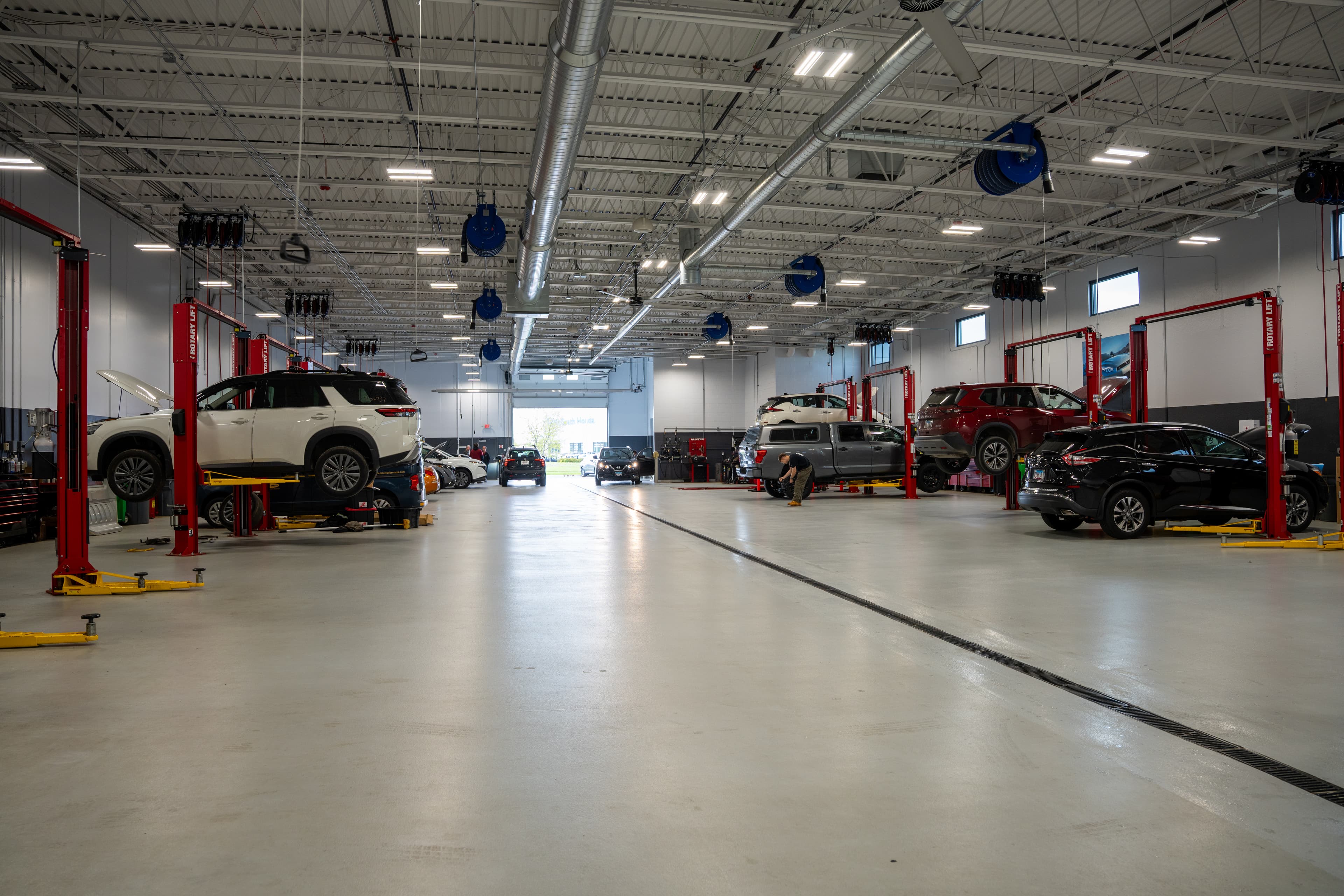
Service department at Nissan of Elgin, a Coleman Automotive dealership. A meaningful share of the work performed in any franchised service drive is billed not to the customer but to the manufacturer. Photo: Sweet Dreams US LLC
Warranty Administration: The Hidden Reimbursement Most Dealers Leave on the Table
Every warranty repair is paid by the manufacturer, at a rate the dealer has a legal right to influence. Most dealers never exercise that right — and the gap shows up every month in fixed operations gross.
When a customer brings a two-year-old vehicle into a franchised service department with a failed water pump, the repair is usually free to the customer. It is not free to anyone else. The dealership performs the work, the technician is paid, the part comes out of inventory, and the dealership submits a claim to the manufacturer for reimbursement. That claim — and the rate at which it is paid — is one of the least-understood line items in dealership economics.
For an investor, warranty is interesting for two reasons. First, it is a recurring, manufacturer-funded revenue stream that does not depend on consumer demand in the way vehicle sales do; recalls and factory warranty repairs arrive whether or not the local economy is strong. Second, the rate at which that work is reimbursed is not fixed. In most states, franchise laws give dealers a statutory right to be paid for warranty parts and labor at something close to the rates they charge retail customers. Many dealers never fully exercise that right, and the difference falls straight to the bottom line of the store that does.
This chapter walks through how warranty claims are generated and paid, how state retail-rate reimbursement statutes generally work, where claims get rejected and charged back, and how Coleman Prime evaluates a target store's warranty operation during diligence. It also closes our module on the service and parts engine.
How a Warranty Claim Gets Paid
Warranty work in a franchised store falls into a few buckets: repairs under the manufacturer's new-vehicle limited warranty (the familiar bumper-to-bumper and powertrain coverages), certified pre-owned warranty repairs, safety recalls, and manufacturer-initiated service campaigns or customer-satisfaction programs. In each case the manufacturer, not the vehicle owner, is the paying customer on the repair order. The reimbursement formula is straightforward in principle. Labor is paid as the manufacturer's published labor time for the operation — the factory flat-rate hours assigned to a specific labor operation code — multiplied by the dealer's approved warranty labor rate. Parts are paid at the dealer's cost plus an approved warranty parts markup. Sublet work, diagnostic time, and certain incidentals are paid under the manufacturer's warranty policy manual, which every brand publishes and updates regularly.
The two numbers that matter most are the warranty labor rate and the warranty parts markup. As we covered in our chapter on effective labor rate, a well-run store's customer-pay effective labor rate is the real price the market pays for an hour of technician time. If the manufacturer is reimbursing warranty hours at a materially lower rate — and warranty parts at a thinner markup than the parts counter earns on retail — then every warranty repair is being performed at a discount to the store's own retail pricing.
Retail-Rate Reimbursement: What State Statutes Generally Provide
The large majority of states have written warranty reimbursement provisions into their motor vehicle dealer franchise statutes — the same body of law we discussed in our chapters on the franchise agreement and franchise law protections. The specifics vary considerably by state, but the core principle is broadly consistent: a manufacturer must compensate its dealers for warranty parts and labor at a rate that is reasonable and, in many states, not less than the rate the dealer charges its retail customers for comparable non-warranty work.
Most statutes establish that retail rate through a defined submission process. The dealer assembles a set of qualifying customer-pay repair orders — commonly 100 sequential customer-pay repair orders or all such orders within a 90-day window, with the exact formula depending on the state — and calculates the average labor rate and parts markup actually charged on them. Statutes typically exclude repairs that would distort the average: routine maintenance, tires, fluids and shop supplies, vehicle reconditioning, discounted or goodwill work, accessory installations, and repairs performed for internal or fleet customers at special pricing.
The manufacturer then usually has a defined window — often around 30 days — to approve the submitted rate or to rebut it with a documented explanation of why it is inaccurate. If the manufacturer does not respond in time or cannot substantiate its objection, the new rate generally takes effect on a schedule the statute sets. Many states limit how often a dealer may file (commonly once per year), and a growing number expressly prohibit manufacturers from recovering higher warranty costs through vehicle price surcharges or other retaliation against dealers who request retail-rate reimbursement.
Two caveats matter. First, the statutes are state-specific, amended frequently, and drafted differently enough that a submission that works in one state may be rejected in another; the details belong with counsel and experienced warranty consultants, not with a general rule of thumb. Second, the right is not self-executing. The manufacturer does not automatically raise a dealer's warranty rate when that dealer raises its retail prices. The dealer has to assemble the repair orders, compute the rates correctly, and file.
By the Numbers
Illustrative Retail-Rate Submission — One Store, One Year
Annual warranty labor hours: 6,000 (for example)
Warranty labor rate before submission: $135/hr vs. customer-pay effective rate of $160/hr
Labor uplift if the retail rate is approved: 6,000 hrs × $25 = $150,000
Annual warranty parts at cost: $900,000; markup moves from 40% to 60% = $180,000
Combined illustrative annual gross uplift: roughly $330,000 — with no new customers, bays, or technicians
The numbers above are illustrative, but the structure is real. Because the incremental revenue arrives with almost no incremental cost — the technician is already paid on the flat-rate hours and the part was already in inventory — nearly the entire uplift drops to gross profit. In a store with a fixed absorption ratio in the 70s or 80s, a few hundred thousand dollars of incremental warranty gross can move that ratio by several points.
Why So Many Dealers Never File
If the economics are this clear, why do so many stores leave the money on the table? In our experience the reasons are mostly operational. Assembling a compliant submission is tedious work: the repair orders must be pulled in the precise sequence the statute requires, each one coded correctly, exclusions applied consistently, and the math defensible line by line when the manufacturer's warranty team reviews it. A single-point store's service manager is rarely staffed to do it well. There is also a pricing discipline problem underneath. A retail-rate submission can only capture the rate a store actually charges. If service advisors routinely discount customer-pay work, or the store has never raised its posted labor rate to market, the submitted average will be low no matter how carefully it is prepared. Warranty reimbursement is therefore downstream of the effective labor rate and parts pricing work we covered earlier in this module — the stores that run tight customer-pay pricing are the stores that earn the most from a submission.
Finally, some dealers are simply reluctant to press the manufacturer. That reluctance is understandable in a relationship that also governs allocation and incentives, but it is the reason so many states wrote anti-retaliation provisions into their statutes. A professionally prepared submission filed under the state's process is the exercise of a statutory right, not a confrontation.
Claims Administration: Where Warranty Dollars Leak
The reimbursement rate is the headline, but day-to-day warranty administration determines how much of that rate the store actually collects. Every claim has to be submitted within the manufacturer's filing deadline, coded to the correct labor operation, and supported by documentation the manufacturer's policy manual requires. The basic standard is often summarized as the three Cs: the customer's complaint, the cause the technician found, and the correction performed — written clearly enough that an auditor reading the repair order months later can follow the diagnosis. Claims that fail those standards are rejected or returned for correction, and every returned claim is working capital tied up in the warranty claims receivable account on the dealer's financial statement. In a well-run store that receivable turns quickly and aged claims are rare. In a poorly run one, the receivable accumulates claims thirty, sixty, and ninety days old — many of which will eventually be written off because nobody had the time to fix and resubmit them.
Diagnostic time is a frequent source of leakage. Modern vehicles can require extended diagnostic work before the actual failure is identified, and manufacturer policies on how much diagnostic time is reimbursable — and what pre-authorization is required — differ by brand. A technician who spends ninety minutes diagnosing an intermittent electrical fault and records it poorly may produce a claim that pays a fraction of the time actually spent. Over thousands of repair orders a year, that difference matters to both the store's gross and the technician's paycheck, which is why warranty labor times are a recurring theme in the pay-plan discussions we covered earlier in this module.
Audits, Chargebacks, and the Administrator's Role
Getting paid on a claim is not the end of the story. Manufacturers audit warranty claims after payment, and if a claim is found to be unsupported — missing technician time punches, a part not retained for return, a repair that does not match the documented cause — the manufacturer can charge the payment back against the dealer's account. Chargebacks from a single audit can reach six figures in a store with sloppy documentation habits. Many state franchise statutes limit this exposure. Common provisions include a cap on how far back a manufacturer can audit paid claims, a requirement that chargebacks be based on material noncompliance rather than clerical errors, a deadline for manufacturers to pay or reject claims after submission, and a right for the dealer to appeal. Those protections help, but they do not substitute for clean files. The best defense against a warranty chargeback is a repair order that would pass the audit on the day it is written.
A related area is recall and stop-sale compensation. When a manufacturer issues a stop-sale on a recalled model, any affected used vehicles in the dealer's inventory cannot be retailed until the remedy is available and performed. Those units still carry floor plan interest and depreciation while they sit. A number of states now require manufacturers to compensate dealers for qualifying used inventory held under a stop-sale, and the claim process for that compensation is another piece of warranty administration that rewards a store paying attention.
In most stores the warranty administrator is a back-office clerical position. In the stores that run warranty well, it is treated as a profit role. The administrator reviews repair orders before submission, coaches technicians on documentation, tracks rejection and chargeback rates by technician and by labor operation, works the aged receivable weekly, and knows the brand's policy manual better than anyone else in the building. At platform scale, that role can be supported by a centralized function that handles retail-rate submissions across every store and every brand on a coordinated calendar, monitors each state's statutory changes, and benchmarks warranty performance across rooftops. A single store rarely justifies that capability. A group of stores does — and this is another example of the operating leverage that comes from consolidating fixed operations disciplines across a platform.
What We Look At in Diligence
When Coleman Prime evaluates an acquisition, warranty administration is one of the first places we look for embedded upside. We compare the store's current warranty labor rate and parts markup against its customer-pay effective rates, and we ask when the last retail-rate submission was filed in each brand — in a surprising number of stores the honest answer is that nobody remembers. We review the aging of the warranty claims receivable, the trailing chargeback history from manufacturer audits, and the rejection rate on submitted claims. We are careful not to underwrite that upside as certain. A retail-rate submission depends on the store's actual customer-pay pricing, the state's statutory formula, and the manufacturer's review, and the result can differ from the estimate. What the diligence does tell us is whether a target has been leaving reimbursement uncollected, and whether the pricing and documentation discipline that would let us collect it is already in place or must be built after closing.
This chapter is general education about how warranty reimbursement typically works; it is not legal advice, and the specific rights available to any dealer depend on that state's statute and the manufacturer's agreements. With warranty, we close Module 3. Next week we cross the building into the business office, where Module 4 opens with a document-by-document look at the F&I menu.
Prime Insight
Coleman Prime reviews warranty labor rates, parts markups, and the date of the last retail-rate submission for every brand at every target store.
Warranty claims receivable aging and manufacturer chargeback history are reviewed alongside the service department P&L, not separately.
After closing, warranty administration is run as a profit role with consistent documentation standards across the platform.
Any submission upside is treated as an operating opportunity to be earned, never as an assumption built into the purchase price.
Prime Dealer Equity Fund is a private equity vehicle co-investing with Coleman Automotive Group in the acquisition and optimization of automotive dealerships across the United States.
For qualified investor inquiries:
→ Contact our investor relations team