
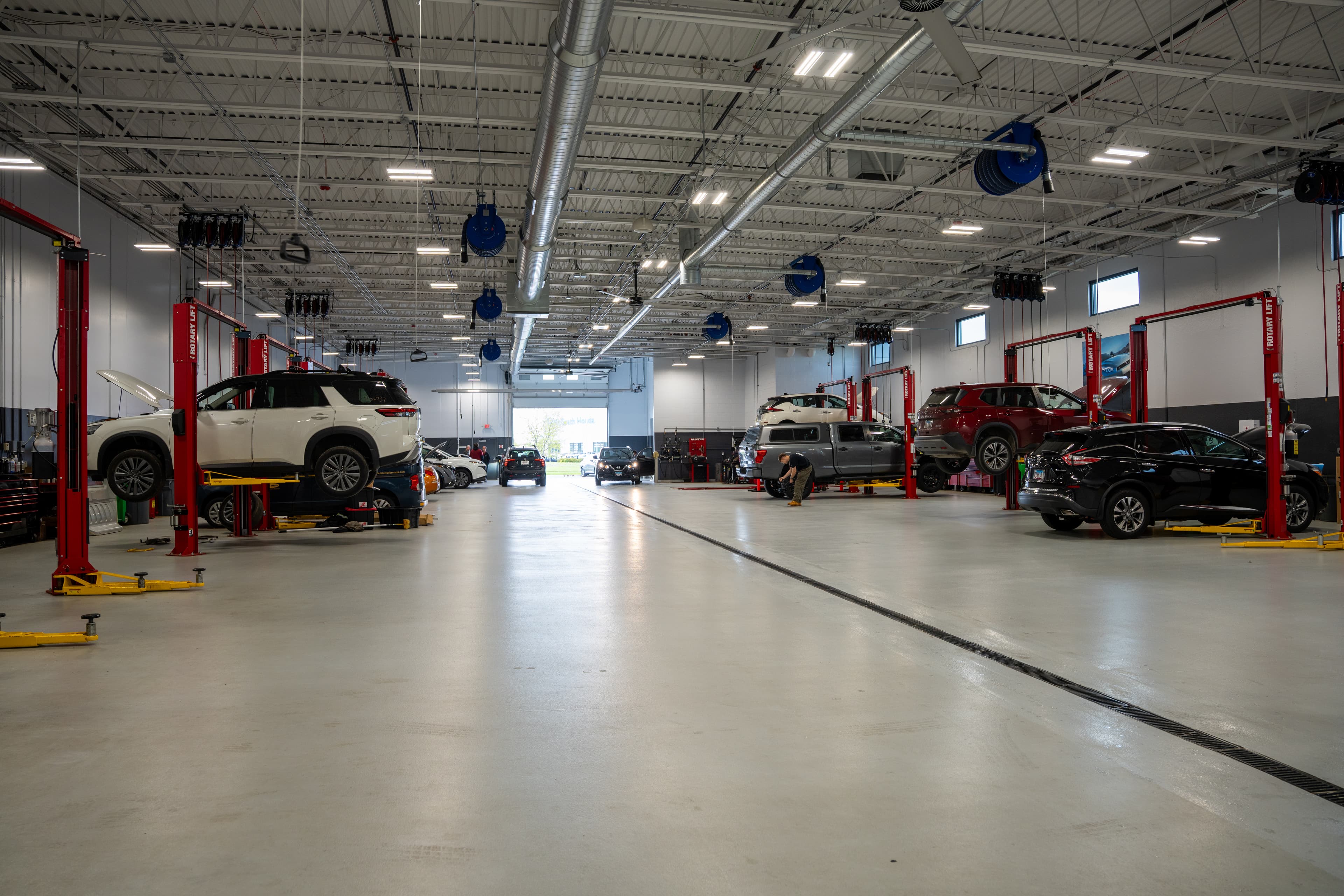
Service department at Nissan of Elgin, a Coleman Automotive dealership in Illinois. The posted labor rate is set in the office; the effective labor rate is earned here, one repair order at a time. Photo: Sweet Dreams US LLC
Effective Labor Rate vs. Posted Labor Rate: How Service Profit Is Engineered
The labor rate on the service menu board is a starting point, not a result. What a service department actually earns per hour sold — its effective labor rate — is shaped by pay mix, discounting, pricing structure, and the discipline of the people writing the repair orders.
Earlier in this series we covered why fixed operations matter so much to the dealership investment thesis: the service and parts departments generate a large share of gross profit on a small share of revenue, and they are the reason a well-run store can cover its overhead even in a weak sales year. Those chapters explained why the service department matters. This module goes inside it to explain how service profit is actually produced — and the first number to understand is the labor rate.
Every franchised service department has a posted labor rate. It is the hourly rate printed on the menu board or quoted on the phone, and it is the rate most outsiders assume the store earns. In practice, very few service departments realize their full posted rate across all the work they perform. The number that matters is the effective labor rate: total labor dollars actually billed, divided by total labor hours actually sold. The gap between the two — sometimes small, sometimes surprisingly large — is one of the most revealing diagnostics in a dealership's financial statement.
This chapter walks through how the effective labor rate is calculated, the five forces that pull it below the posted rate, the related productivity metrics that determine how many hours a shop can sell in the first place, and how Coleman Prime uses these numbers to separate a service department's true earning power from its menu board.
Two Rates, One Department
The posted labor rate is a pricing decision. Management sets it based on local competition, brand positioning, cost structure, and — importantly — what the store expects to be reimbursed for warranty work, which we will discuss below. It is the rate a customer would pay for one hour of labor on a straightforward customer-pay repair with no discounts. The effective labor rate, often abbreviated ELR, is an outcome. It is calculated by taking total labor sales over a period and dividing by total hours sold — the hours billed on repair orders, regardless of how long the technician actually took. For example, if a department billed $210,000 of labor in a month and sold 1,750 hours, its overall effective labor rate is $120 per hour. If its posted rate is $150, it is realizing about 80% of its posted rate across all work.
That 80% figure is not inherently good or bad. It depends entirely on what is pulling the number down — and that is why experienced operators never look at the overall ELR alone. They break it out by pay type: customer-pay, warranty, internal, and in some cases fleet or service contract. Each pay type has its own rate dynamics, and a single blended number hides more than it reveals.
By the Numbers
An Illustrative ELR by Pay Type
Posted customer-pay rate: $150 per hour (for example)
Customer-pay: 900 hours at $138 effective → $124,200
Warranty: 450 hours at $130 effective → $58,500
Internal (reconditioning, used-car prep): 400 hours at $68 effective → $27,200
Overall: 1,750 hours, $209,900 of labor sales → roughly $120 effective, about 80% of posted
Raising customer-pay ELR by $10 per hour on the same hours adds roughly $9,000 of monthly labor gross
Force One: Pay-Type Mix
The single largest driver of overall ELR is the mix of work. Internal work — the reconditioning of used vehicles before they go on the lot, accessory installs on new vehicles, and other jobs the dealership bills to itself — is typically charged at a reduced internal rate. That is a deliberate choice. Charging the used-car department full retail for reconditioning would inflate service gross at the expense of used-car gross, and it would make used inventory more expensive to bring to the front line. Most groups set an internal rate that covers technician cost and a reasonable margin, and accept that it pulls the blended ELR down.
A store with a large used-car operation will therefore show a lower overall ELR than a store with little reconditioning, even if both price customer-pay work identically. That is why comparing two stores on blended ELR without looking at mix is misleading — and why, in diligence, we always want the ELR broken out by pay type before drawing any conclusion.
Force Two: Warranty Reimbursement
Warranty work is paid by the manufacturer, not the customer, and the manufacturer historically reimbursed dealers at a warranty labor rate that could sit well below the dealer's retail rate. Over time, most states have adopted dealer franchise statutes that require manufacturers to reimburse warranty labor — and in many states, warranty parts — at a rate tied to what the dealer actually charges retail customers, typically calculated from a sample of qualifying customer-pay repair orders under a formula defined in the statute.
The practical result is that a store's warranty labor rate is partly a function of its own customer-pay pricing discipline. A store that discounts customer-pay work heavily drags down the retail-rate calculation that would otherwise support a higher warranty reimbursement. A store that holds its customer-pay rate and documents it properly can often apply for a warranty rate increase under the applicable statute. We will cover warranty administration in detail in Chapter 17; the relevant point here is that customer-pay pricing and warranty reimbursement are linked, and a weak ELR in one tends to show up in the other.
Force Three: Discounting and Policy Work
Every service department discounts. Coupons, loyalty programs, first-responder and military discounts, price-matching against independent shops, and advisor-discretionary discounts to close a sale on the drive all reduce the labor dollars billed on an hour sold. Some of this is smart marketing. Much of it is leakage — discounts given out of habit, without approval, on work the customer would have purchased anyway. Policy and goodwill work belong in the same category. When a vehicle is just out of warranty and the customer has a legitimate grievance, the dealer and manufacturer will often share the cost of a repair as goodwill. When a comeback occurs — a repair that did not fix the problem — the store redoes the work at no charge. Each of these hours is real work performed by a technician, but it generates little or no labor revenue. A department with high comeback rates or loose policy approval will see its ELR erode no matter what its posted rate says.
Force Four: How Work Is Priced
The fourth force is the pricing structure itself. Most customer-pay work is priced off published labor-time guides, which assign a standard number of hours to each operation. But many departments also sell maintenance and common repairs as fixed-price menu items — an oil change, a brake job, a fluid service at a set price. If those menu prices are not updated when the posted rate changes, or were built off an outdated labor time, the effective rate on menu work quietly drifts below the posted rate.
More sophisticated operators use a labor-rate matrix: different rates for different categories of work, reflecting the skill required, the equipment involved, and what the local market will bear. Diagnostic and electrical work, which requires the most experienced technicians and the most expensive tooling, may carry a higher rate. Light maintenance, which competes directly with quick-lube chains, may carry a lower one. A well-designed matrix can raise overall customer-pay ELR while keeping maintenance pricing competitive — but only if it is designed deliberately and reviewed regularly.
Force Five: Advisor Discipline on the Repair Order
The last force is human. The service advisor writes the repair order, presents the recommended work, quotes the price, and decides whether to discount. An advisor who sells a diagnostic hour, documents the technician's findings clearly, and presents additional needed repairs with photos or video will produce a higher ELR and more hours per repair order than one who waives the diagnostic fee to avoid an awkward conversation. The same posted rate produces very different results depending on who is standing at the write-up desk.

Hours Sold: The Other Half of the Equation
Labor gross is the effective rate multiplied by hours sold, so rate is only half the story. The other half is how many hours the shop can produce. Three related metrics capture this. Productivity measures the share of a technician's paid time actually spent working on vehicles. Efficiency — sometimes called proficiency — measures hours flagged (billed) against hours actually worked; a technician who completes a job rated at 2.0 hours in 1.6 hours is running at 125% efficiency on that job. Overall technician performance combines the two: hours flagged divided by hours available. Hours per repair order is the related customer-facing measure. It reflects how thoroughly vehicles are inspected and how effectively advisors present needed work. A shop averaging 1.4 hours per customer-pay repair order and one averaging 2.0 hours may have the same car count — but the second shop is selling roughly 40% more labor on every vehicle that comes through the door. That difference compounds across thousands of repair orders a year.
Put the two halves together and the levers become clear. A service department can grow labor gross by raising its effective rate, by selling more hours per repair order, by increasing technician productivity and efficiency, or by bringing more vehicles through the drive. Each lever requires a different management action, and each shows up in a different line of the departmental statement. How technicians are paid — the subject of next week's chapter — sits right in the middle of all of them.
How Coleman Prime Reads the Numbers
In diligence, we rebuild the service department's ELR from repair-order data by pay type and by labor operation, rather than relying on a single blended figure from the financial statement. We compare customer-pay ELR to the posted rate and look at where the discounts are coming from. We review the store's current warranty reimbursement rate against what its customer-pay history could support under the applicable state statute. We look at hours per repair order, technician efficiency, and comeback rates side by side.
The output is not a promise that labor gross will rise. It is a clear map of where the gap between posted and effective rate comes from, which parts of that gap are deliberate choices, and which are leakage that process and training can address. That map is what lets us underwrite a service department on its true earning power — not on its menu board.
Prime Insight
Coleman Prime rebuilds effective labor rate by pay type and labor operation from repair-order data on every acquisition target.
Discounting, policy work, menu pricing, and warranty reimbursement are each reviewed separately, so we can distinguish deliberate pricing choices from leakage.
After acquisition, labor pricing, advisor discount authority, and hours-per-RO targets are managed through the Coleman Automotive Group fixed-operations playbook and reviewed weekly.
Prime Dealer Equity Fund is a private equity vehicle co-investing with Coleman Automotive Group in the acquisition and optimization of automotive dealerships across the United States.
For qualified investor inquiries:
→ Contact our investor relations team