

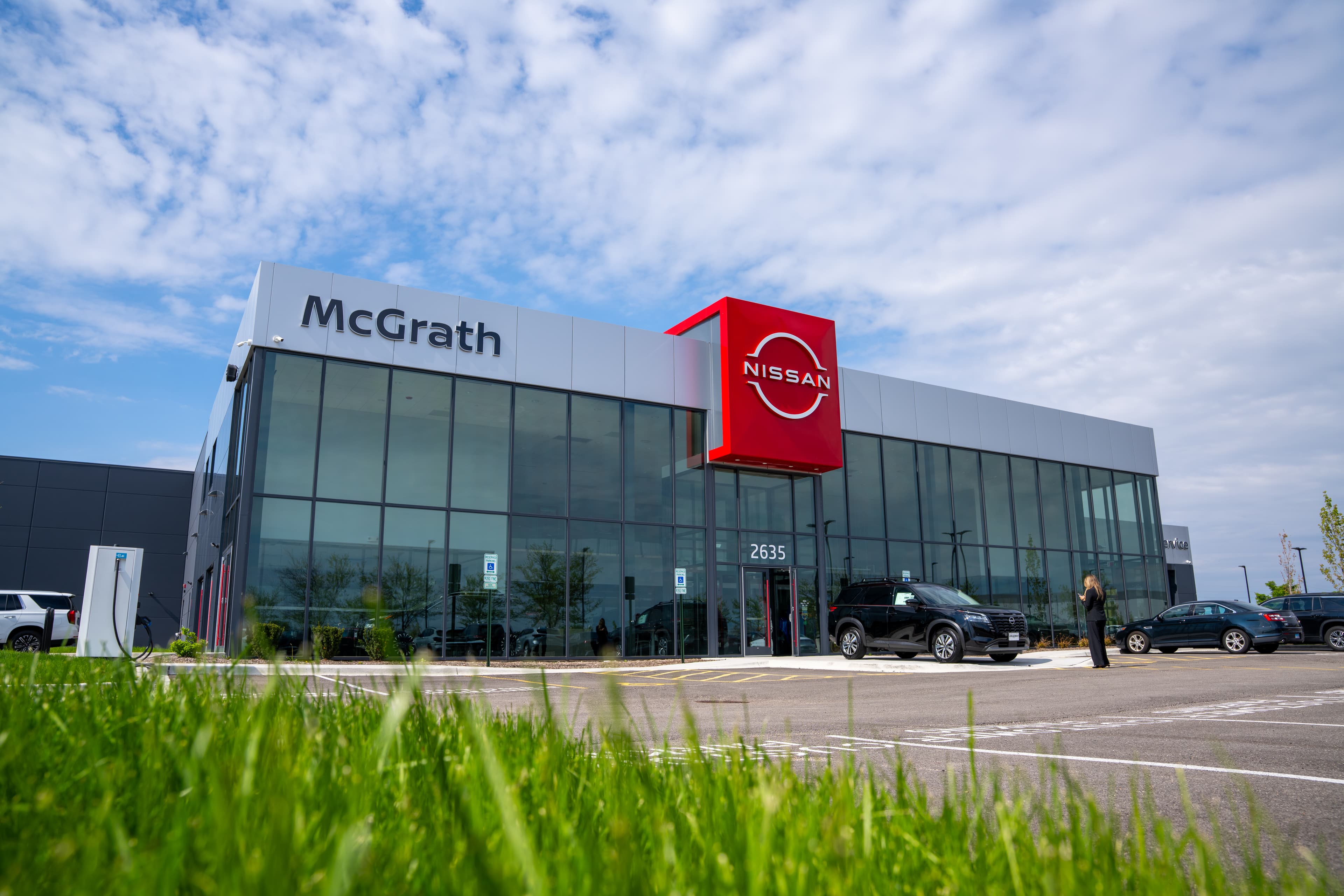
Front of store at the Streetsboro dealership in Ohio, a Coleman Automotive location. Behind the showroom, the service department's capacity depends on recruiting and keeping skilled technicians — and pay plan design is central to both. Photo: Sweet Dreams US LLC
Technician Pay Plans: Flat Rate, Hourly, or Hybrid?
Technicians are the scarcest resource in a dealership, and how they are paid shapes how much the service department produces, how long good technicians stay, and how the work gets done. There is no perfect plan — only tradeoffs an operator must manage deliberately.
Last week we looked at the effective labor rate — what a service department actually earns for each hour it sells. Rate is only one side of the equation. The other side is how many hours the shop can produce, and that depends almost entirely on technicians: how many the store has, how skilled they are, how productive they are, and whether they stay.
Technicians are, for most franchised dealers, the binding constraint on fixed-operations growth. Industry groups have reported a persistent gap between the number of new technicians entering the field and the number the industry needs, and most dealers will tell you that finding and keeping experienced, factory-certified technicians is harder than finding customers. In that environment, the technician pay plan is not an HR detail. It is one of the most consequential operating decisions a dealership makes.
This chapter walks through the three main approaches — flat rate, hourly, and hybrid — what each one rewards and risks, the legal requirements that shape pay design, the economics of how pay plans connect to labor gross, and how Coleman Prime evaluates technician compensation when we diligence a store.
Flat Rate: Paying for Hours Produced
Under a flat-rate plan, a technician is paid a set dollar amount for each hour flagged — the standard labor time assigned to the job — rather than for each hour on the clock. If a brake job is rated at 1.5 hours and the technician completes it in 1.0 hour, they are paid for 1.5. If it takes 2.5 hours, they are still paid for 1.5. The technician's earnings depend on how many hours of work they complete, not how long they are in the building.
Flat rate has been the dominant model in dealership service for decades, and the logic is straightforward. It aligns technician pay with what the dealership sells. A fast, skilled technician can flag far more hours than they clock and earn substantially more than a slower peer. The dealership's labor cost tracks closely with its labor sales, which protects margin when work is slow. For example, a technician paid $32 per flagged hour who flags 50 hours in a 40-hour week earns $1,600; the store has billed those 50 hours at its effective rate and its technician cost as a share of labor sales stays roughly constant.
The weaknesses are equally well known. Flat rate shifts the risk of slow periods onto the technician: when car count drops or parts are back-ordered, a flat-rate technician sits waiting and earns little. It can create tension over job dispatch, since some repair types pay well relative to the time they take and others — certain diagnostic and electrical work in particular — often take longer than the labor guide allows. It can also discourage technicians from taking on difficult warranty work or training time, and in the worst cases it rewards speed over quality, which shows up later as comebacks.
Hourly: Paying for Time
Under an hourly plan, the technician is paid for each hour on the clock regardless of how many hours they flag. Pay is predictable, which matters to younger technicians building a career and to experienced technicians tired of income volatility. Hourly plans make it easier to assign diagnostic work, training, and complex warranty repairs without dispatch disputes, and they can support a more team-oriented shop culture.
The risk moves to the dealership. If technician efficiency slips, labor cost rises as a share of labor sales and margin erodes. A pure hourly plan offers no direct financial incentive for productivity, so management has to supply that incentive through supervision, dispatch, and performance standards. Hourly plans work best in shops with strong workflow management — where the bottleneck is not technician effort but the flow of work to the bays.
By the Numbers
An Illustrative Comparison: One Technician, One Week
For example: technician clocks 40 hours and flags 46 hours of work
Flat rate at $32 per flagged hour → $1,472 pay
Hourly at $34 per clocked hour → $1,360 pay
Hybrid: $24 base per clocked hour plus $10 per flagged hour above 36 → $960 + $100 = $1,060 base-and-bonus, before any efficiency tiers
Each plan pays differently for the same week — what matters is the behavior it rewards and the labor cost it produces as a share of labor sales
Hybrid Plans: Trying to Get the Best of Both
Hybrid plans combine a guaranteed base with a productivity component. The structures vary widely. Some pay an hourly base plus a bonus for flagged hours above a weekly threshold. Some guarantee a minimum number of flagged hours per week, so a technician on flat rate is protected during slow periods. Others pay flat rate with tiered rates — the per-hour rate steps up as the technician's weekly efficiency rises past defined levels. Many also layer in bonuses for factory certification, low comeback rates, or customer satisfaction scores.
The appeal of a hybrid is that it shares risk. The technician gets stability; the dealership keeps a productivity incentive. The challenge is complexity. A hybrid plan with too many moving parts becomes hard for technicians to understand and hard for payroll to administer correctly — and a plan the technician cannot easily calculate is a plan they will not trust. The best hybrid plans we have seen are simple enough to explain on a single page and reward a small number of clearly measurable outcomes.
The Legal Framework Behind Pay Design
Pay plan design is constrained by wage-and-hour law. Under the federal Fair Labor Standards Act, flat-rate and other incentive-based technicians must still receive at least the minimum wage for all hours worked in a workweek, which means the dealership must track clocked time and make up any shortfall. The FLSA also contains an overtime exemption, in Section 13(b)(10)(A), for salespeople, partsmen, and mechanics primarily engaged in selling or servicing automobiles at a qualifying dealership — the provision the U.S. Supreme Court interpreted in its 2018 Encino Motorcars v. Navarro decision as applying to service advisors.
State law can be considerably stricter. California, for example, requires piece-rate workers — which includes flat-rate technicians — to be separately compensated for rest and recovery periods and other nonproductive time, and to have those amounts itemized on wage statements. Other states have their own minimum wage, overtime, and wage-statement rules. For a multi-state dealership group, the practical lesson is that a pay plan that works in one state may need to be modified in another, and that time-tracking and payroll records are a real diligence item, not a formality. This is general education, not legal advice; dealers should rely on employment counsel for the rules that apply to their specific stores.
How Pay Plans Connect to Service Profit
The economic link between technician pay and service profitability runs through a single ratio: technician labor cost as a share of labor sales. For example, if a store's customer-pay effective labor rate is $138 and a flat-rate technician earns $32 per flagged hour, the direct technician cost on that hour is about 23% of the labor sale, leaving roughly 77% as labor gross before other service department costs. Industry benchmarks commonly cite service labor gross margins in the 70–75% range, consistent with this math.
On hourly plans, the ratio depends on efficiency. If the same technician is paid $34 per clocked hour and flags 1.15 hours for every hour worked, the cost per flagged hour is about $29.60 — lower than the flat-rate example. If efficiency falls to 0.85, the cost per flagged hour rises to $40 and labor gross margin compresses. This is the central tradeoff: flat rate makes labor cost predictable as a share of sales, while hourly makes it predictable as a share of payroll. Hybrid plans sit somewhere in between, which is why the right answer depends on the shop. Pay plans also affect the hours side of the equation from the previous chapter. A plan that leaves technicians idle when work is slow encourages them to leave for a competitor or an independent shop. A plan that rewards speed without regard to quality drives comebacks, which consume unpaid hours and pull down effective labor rate. A plan that makes diagnostic work unattractive leaves the hardest jobs sitting in the lot. Every one of these outcomes shows up on the service department's statement.
Retention: The Number Behind the Numbers
The most expensive technician is the one who leaves. A departing experienced technician takes capacity, factory certifications, customer relationships, and sometimes other technicians with them. Replacing that capacity can mean recruiting costs, sign-on incentives, tool allowances, months of reduced productivity while a new hire learns the shop, and lost hours that never get sold. Technicians typically own their own tools — often a substantial personal investment — so the decision to move is not taken lightly, which makes a well-regarded shop sticky in both directions.
That is why we view pay plan design and retention as a single question. Pay matters, but so do the things around it: a fair and transparent dispatch system, a clean and well-equipped shop, a clear path to factory certification and master-technician status, apprenticeship and mentoring for newer technicians, and a service manager who keeps work flowing to the bays. We will go deeper into technician recruiting and the talent pipeline in a later chapter in Module 6.
What We Look For in Diligence
When Coleman Prime evaluates a dealership, we review the current technician pay plans in writing, compare them to what each technician has actually been paid, and check that time records and wage statements support compliance with federal and state requirements. We look at technician tenure and turnover over several years, efficiency and productivity by technician, comeback rates, and the mix of certification levels across the shop. We also ask a simple question that often reveals a great deal: can the technicians explain how they are paid?
We do not assume that one pay model is right for every store. A high-volume shop with strong workflow and experienced technicians may perform best on flat rate with tiered incentives. A smaller rural store building its bench with younger technicians may benefit from more base-pay stability. The goal is a plan that is legally sound, simple to understand, fair to the technician, and aligned with the labor gross the department needs to produce — and then the management discipline to keep work flowing so the plan works as designed.
Prime Insight
Coleman Prime reviews technician pay plans, payroll records, tenure, and efficiency data as part of operational and compliance diligence on every acquisition.
Pay plan changes after acquisition are made deliberately, with attention to retention risk, state wage-and-hour requirements, and the labor gross the department needs to sustain.
Our operating philosophy is talent first: recruiting, certification, and keeping experienced technicians are treated as core fixed-operations priorities across Coleman Automotive Group.
Prime Dealer Equity Fund is a private equity vehicle co-investing with Coleman Automotive Group in the acquisition and optimization of automotive dealerships across the United States.
For qualified investor inquiries:
→ Contact our investor relations team