
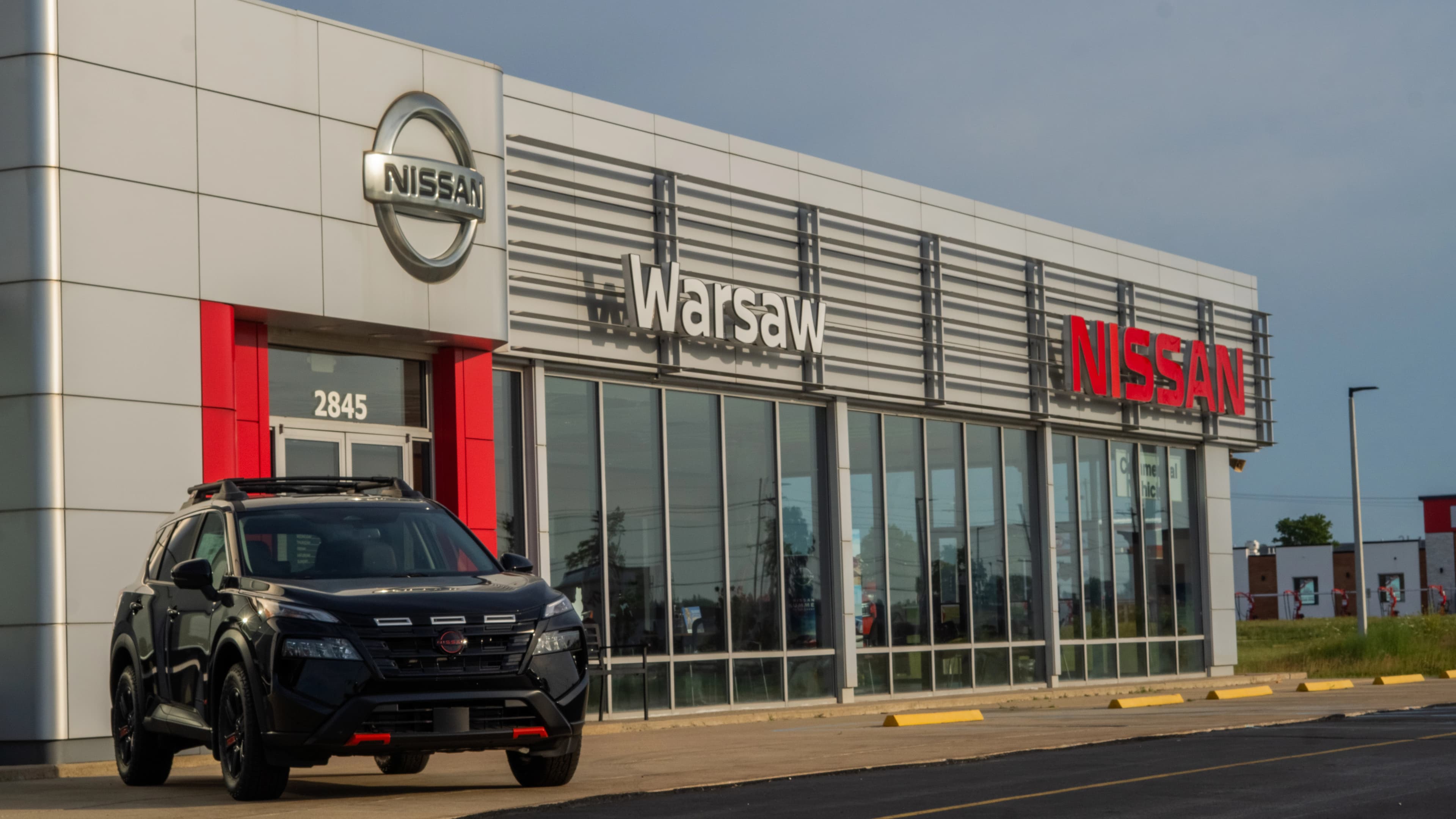
Front of store at Nissan of Warsaw, a Coleman Automotive dealership. Before most customers walk through this door, they have already been answered — or ignored — by the store's business development center. Photo: Sweet Dreams US LLC
The BDC: Why Lead Response Time Is the #1 Conversion Lever
Every dealership pays to generate leads. Far fewer have the discipline to answer them quickly and well. The business development center is where that discipline lives — and where marketing dollars either turn into appointments or quietly disappear.
Over the past four chapters we followed a vehicle sale from the first conversation on the lot, through the desk, through the trade appraisal, and into the digital retailing tools that now let a customer do much of the work from a phone. There is one piece of the variable-operations machine we have not yet examined, and it sits upstream of all of them: the moment a shopper raises their hand and the dealership has to respond.
That moment is usually a lead — an internet inquiry, a phone call, a chat message, a text, a credit application, a trade-in valuation request. Every one of those leads cost the dealership money to generate, whether through third-party listing sites, OEM lead programs, paid search, or the store's own website. And every one of them has a short shelf life. A shopper who submits an inquiry at 7:40 on a Tuesday evening has often submitted two or three others at competing stores in the same session. The store that answers first, and answers well, usually gets the appointment.
For an investor, this is not a marketing detail. Lead handling is the conversion step that determines whether a dealership's advertising budget produces sold units or simply produces data. This chapter walks through what a business development center actually does, why lead response time is the single most important lever it controls, how a well-run BDC is measured, and how Coleman Prime evaluates lead-handling discipline when we diligence a store.
What a Business Development Center Actually Is
A business development center, or BDC, is the team responsible for converting inbound and outbound customer contact into scheduled appointments. In a smaller store it might be two or three people sitting near the sales floor. In a larger store or a multi-rooftop group it can be a dedicated department — sometimes centralized across several locations — with its own manager, scripts, phone system, CRM workflows, and performance targets. The BDC's job is narrow by design. It is not there to negotiate price or desk deals. Its job is to make contact, answer the shopper's immediate question, confirm the vehicle or service need, and set a specific appointment with a specific person at a specific time. Once the customer arrives, the sales or service team takes over. Separating these roles matters because the skills are different: a BDC agent is measured on speed, consistency, and appointment quality, while a salesperson is measured on closing and gross.
Most dealerships run BDC functions on both sides of the building. The sales BDC handles vehicle inquiries, unsold-showroom follow-up, and equity-mining campaigns aimed at existing customers who could trade into a new vehicle at a similar payment. The service BDC handles appointment scheduling, recall outreach, declined-repair follow-up, and maintenance reminders. Both run on the same underlying principle: the dealership pays to create a contact, and the BDC exists to make sure that contact is not wasted.
Why Speed Matters More Than Almost Anything Else
The case for fast lead response is well documented across industries. Widely cited research on online sales leads, including a frequently referenced study published in Harvard Business Review, found that companies responding within the first hour were dramatically more likely to qualify a lead than those that waited even a few hours longer — and that many companies took far longer than an hour to respond at all. Dealership-specific lead studies have reached directionally similar conclusions for years: contact rates and appointment rates fall off quickly as response time stretches from minutes to hours.
The reasons are intuitive once you think about how people shop for vehicles today. Cox Automotive's car buyer research has consistently shown that most of a shopper's time is spent online before they ever visit a store, and that shoppers often narrow their list to a small number of dealerships. When a shopper submits an inquiry, they are at peak attention — the vehicle is on the screen, the question is in their head, and they are ready to talk. Ten minutes later they may be on another site. Two hours later they may have already scheduled a test drive somewhere else.
There is also a credibility effect. A store that responds in four minutes with a real answer signals that it is organized and that the customer's time matters. A store that responds the next morning with a generic template signals the opposite — and the customer reasonably wonders what the rest of the experience will be like. The first response is the first test drive of the dealership itself.
By the Numbers
An Illustrative Lead Funnel
For example: 600 internet and phone leads in a month at a single rooftop
Contact rate of 70% → 420 live conversations
Appointment-set rate of 50% of contacts → 210 appointments
Show rate of 60% → 126 customers on the lot
Close rate of 45% of shows → roughly 57 units sold from leads
Lift contact rate to 80% with faster response and the same funnel yields roughly 65 units — about 8 more sales from the same ad spend
The Funnel Math: Where Leads Leak
The illustrative funnel above is simple, but it captures the mechanics every BDC manager lives with. A lead becomes a sale only after passing through four gates: contact, appointment, show, and close. Each gate has its own conversion rate, and the rates multiply. That multiplication is why small improvements at the top of the funnel produce outsized changes at the bottom. Response time drives the first gate more than any other variable. A shopper reached within minutes is far more likely to pick up the phone or reply to a text than one reached the next day. But speed alone is not enough. The second gate — turning a conversation into a firm appointment — depends on whether the agent actually answers the question asked. If the shopper wanted to know whether a specific vehicle was still in stock and what the out-the-door price looks like, a reply that ignores the question and pushes for a visit will often lose them.
The third gate, show rate, is where appointment quality is exposed. An appointment set with a vague time and no named contact is not much of an appointment. Well-run BDCs confirm the appointment the day before and the morning of, send the customer the salesperson's name and photo, confirm the vehicle is pulled up and ready, and in some cases have the appraisal or credit work started in advance. Each of those steps reduces no-shows. The fourth gate, close rate, belongs mostly to the sales floor — but a customer who arrives expecting a specific vehicle, a specific person, and a prepared deal closes at a meaningfully higher rate than a customer who walks in cold.
How a Well-Run BDC Is Measured
The core BDC scorecard is short and should be reviewed daily. Average response time — measured from lead receipt to first genuine human contact, not to the automated acknowledgment email — is the headline. Contact rate, appointment-set rate, show rate, and sold-from-appointment rate follow. Many stores also track cost per lead and cost per sale by lead source, which tells management which advertising channels are actually producing buyers and which are producing noise. Phone handling deserves its own line. A surprising share of high-intent shoppers still call, and calls are easy to mishandle: long holds, transfers to voicemail, salespeople who answer a price question with a question. Most well-run groups record and score inbound calls, track the percentage of sales calls that result in a set appointment, and monitor missed-call rates by hour of day. The pattern that shows up again and again is that leads arriving in the evening and on weekends — when many shoppers actually have time to look — are the ones most likely to wait the longest for a response.
Finally, the BDC should be measured on follow-up persistence. Most leads do not convert on the first contact. A disciplined follow-up cadence — a defined sequence of calls, texts, emails, and video messages over the first several days, then a longer nurture cadence for shoppers with a longer timeline — is what separates a store that converts its leads from one that simply logs them. The CRM should show this cadence clearly. If a lead's history shows one email and then silence, the problem is process, not the customer.
Centralized vs. In-Store BDC
One of the structural questions every multi-rooftop group has to answer is whether to run the BDC inside each store or centralize it. An in-store BDC knows the inventory, the people, and the local market intimately. Agents can walk out to the lot and confirm a vehicle is there. Hand-offs to the sales floor are face to face. The tradeoff is coverage and consistency: a two-person team cannot answer every lead in minutes during a busy Saturday, and quality varies from store to store depending on who is running it. A centralized BDC solves the coverage problem. A larger team can staff longer hours, absorb volume spikes, standardize scripts and follow-up cadences, and give management a single view of response performance across the group. The tradeoff is distance — agents need real-time inventory visibility and a clean hand-off process, or the customer arrives at a store that does not know they are coming. Many groups end up with a hybrid: a central team handles first response, after-hours coverage, and service scheduling, while each store keeps a small team for local follow-up and appointment confirmation. We will return to the broader centralization question in our later chapter on multi-rooftop management.
Technology now shapes this decision as much as staffing. Automated first-touch responses, text-enabled CRMs, and AI-assisted chat tools can acknowledge a lead in seconds at any hour. Used well, they buy the dealership time and answer simple questions. Used poorly, they produce a wall of canned replies that the customer quickly learns to ignore. The standard we hold is simple: automation can start the conversation, but a knowledgeable human should be in it quickly — and the customer should never have to repeat information they already provided.
Compliance in the BDC
Speed cannot come at the expense of compliance. Outbound calling and texting are governed by the Telephone Consumer Protection Act, which restricts autodialed and prerecorded calls and texts to consumers without the appropriate consent, along with the federal Do Not Call rules and a growing number of state-level telemarketing laws. Customer information collected through leads and credit applications falls under the FTC Safeguards Rule we covered in our chapter on dealer licensing and regulation. And any price or payment quoted by a BDC agent is an advertising and disclosure matter, not just a sales conversation.
A well-run BDC builds compliance into its tools and scripts: consent captured and recorded at the point of lead submission, opt-out handling that works immediately, call recording disclosures where required, and pricing language reviewed by management. These are not exotic controls. They are basic hygiene — but in diligence we find that stores with weak response discipline often have weak compliance discipline too, because both come from the same lack of process.
What Investors Should Ask to See
When we evaluate a dealership, we ask for at least ninety days of CRM data on lead volume by source, average and median response time, contact and appointment rates, show rate, and sold rate. We look at response time by hour and day of week, because a store that answers quickly at 10 a.m. on a Wednesday but takes fourteen hours to answer a Saturday-night inquiry has a staffing problem the averages will hide. We listen to a sample of recorded calls. And when it is appropriate, we submit test leads of our own to see what a real shopper experiences.
What we are looking for is not perfection. It is the gap between how leads are being handled today and how they could be handled with clear process, appropriate staffing, and daily accountability. Because the funnel multiplies, closing that gap is often one of the faster operational improvements available after an acquisition — it requires no new building, no new franchise, and no change in inventory. It requires the discipline to answer the customer, quickly and well, every time. That discipline closes out our look at variable operations. Next week, Module 3 moves to the other side of the building: the service and parts engine.
Prime Insight
Coleman Prime reviews CRM lead-handling data — response time, contact, appointment, show, and sold rates — as part of operational diligence on every acquisition.
Response time is examined by hour and day of week, not just as a monthly average, so after-hours and weekend gaps are visible before we close.
After acquisition, BDC process, staffing, follow-up cadence, and compliance controls are standardized under the Coleman Automotive Group operating playbook and reviewed daily by store leadership.
Prime Dealer Equity Fund is a private equity vehicle co-investing with Coleman Automotive Group in the acquisition and optimization of automotive dealerships across the United States.
For qualified investor inquiries:
→ Contact our investor relations team