
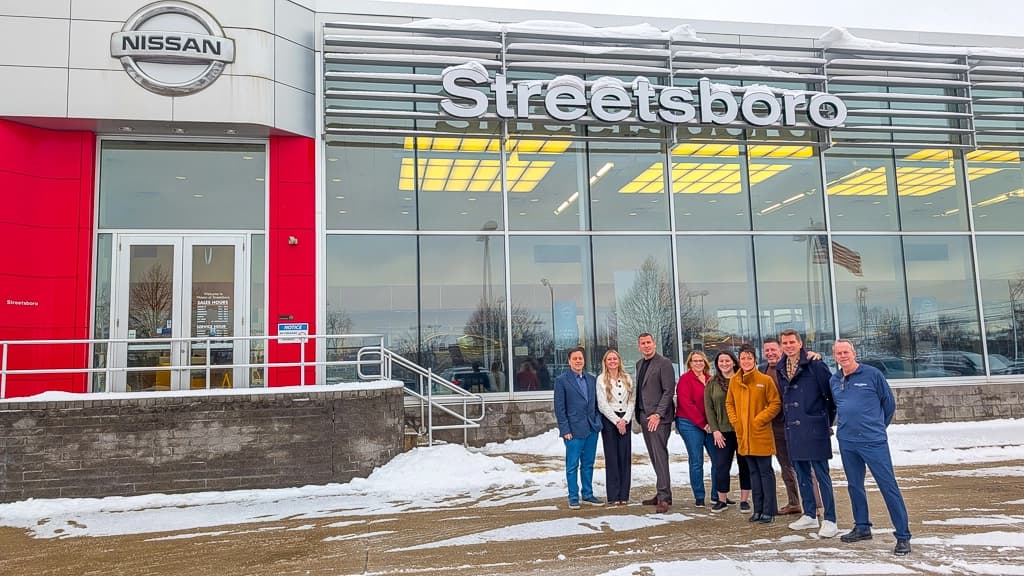
Front of the Streetsboro store in Ohio, a Coleman Automotive dealership. For many customers, the visit to this building is now the last step of a purchase that began online. Photo: Sweet Dreams US LLC
Digital Retailing: How Online Sales Are Reshaping the Showroom
Customers increasingly want to start — and sometimes finish — a vehicle purchase online. For a franchised dealer, the question is not whether to sell digitally, but how to connect the online and in-store experience into one process.
Over the past several chapters, we walked through the traditional dealership sales process, how front-end gross is built at the desk, and how used vehicles are appraised and sourced. Each of those processes was designed around a customer who sat across a desk from a salesperson. Increasingly, a large part of the work now happens before the customer ever arrives — on a phone, at a kitchen table, at eleven at night.
Digital retailing is the industry's name for the tools and processes that let customers complete steps of a vehicle purchase online. Online-only used-vehicle retailers made the concept famous, and the disruptions of 2020 accelerated adoption across franchised dealerships. Today, nearly every franchised store offers some form of online deal-building. The question for investors is no longer whether a store has digital retailing, but whether it actually works — whether the online deal and the in-store deal are the same deal.
This chapter walks through what digital retailing includes, how customers actually use it, its effects on gross and efficiency, the operational and compliance requirements of doing it well, and what investors should look for in diligence.
What Digital Retailing Actually Includes
At its most basic, digital retailing is a set of tools embedded in a dealership's website and vehicle listing pages. A customer selects a vehicle and can then see a real selling price with taxes and fees, calculate payments for cash, finance, and lease options, receive an estimated value for a trade-in, apply for credit, view and select protection products, place a deposit, and schedule a test drive, pickup, or delivery. Platforms from vendors such as CDK's Roadster, Cox Automotive, Upstart, and others provide these tools to franchised dealers, often integrated with the dealer's CRM, DMS, and desking systems.
The depth of the integration is what separates a useful tool from a lead form with a calculator. In a shallow implementation, the customer builds a deal online, the store receives an email, and a salesperson starts over from scratch. In a deep implementation, the customer's selected vehicle, trade information, credit application, payment structure, and product selections flow directly into the store's systems, and the salesperson picks up exactly where the customer left off.
Online-only retailers built their processes digitally from the start. Franchised dealers have had to retrofit digital steps onto systems and pay plans designed for the showroom. That retrofit is harder than it looks, and the quality of the execution varies enormously from store to store. Two dealerships can license the same platform and see very different outcomes, because the software is only as good as the pricing data behind it, the speed of the people who respond to it, and the willingness of the sales desk to honor what the customer built.
How Customers Actually Use It
Research from Cox Automotive, J.D. Power, and others has consistently shown that buyers want to complete more of the purchase online — especially the parts they find most time-consuming or least pleasant, such as negotiating price, valuing the trade, and completing paperwork. At the same time, the same research has found that most buyers still want to see and drive the vehicle in person, and only a minority want to complete the entire purchase without visiting a dealership.
In practice, this means most digital retailing customers are omnichannel customers. They may build a deal online, visit the store to drive the vehicle and finalize paperwork, and take delivery at the store or at home. Or they may arrive with a trade estimate and a pre-qualification, buy a different vehicle than the one they built online, and finish everything in person. A store's process has to accommodate every one of these paths without making the customer repeat steps. The most common failure point is the handoff: a customer who has already entered their address, trade details, and credit information online and is then asked to fill out the same paper forms at the desk quickly concludes that the online experience was for show.
For a franchised dealer, this is good news. The physical store remains valuable — for test drives, deliveries, and, crucially, for service. A customer who completes most of the purchase online still needs a place to have the vehicle serviced, and the franchised dealer is the natural home for warranty and recall work. Digital retailing does not replace the rooftop; it changes what happens under it. It also gives the store a richer record of each customer's preferences, which supports follow-up, retention, and future service marketing.
The Effect on Gross and Efficiency
A common concern is that showing real prices and payments online compresses front-end gross. There is some truth to it: transparent pricing reduces the room for negotiation, and online shoppers compare prices across stores. But price transparency was already the reality of the market — customers could see competitor listings long before digital retailing tools existed. The more useful question is whether digital retailing changes the total economics of a sale.
Done well, it can. A customer who arrives with a structured deal, a completed credit application, and an appraised trade typically spends less time in the store, and that saved time is capacity: a salesperson and a sales manager can handle more transactions per day. Customers who engage with protection products online, with time to read about them, may be more receptive in the F&I office than customers encountering them for the first time at the end of a long visit. And a faster, more predictable experience tends to support CSI, which, as we have discussed, feeds manufacturer incentive eligibility.
By the Numbers
Illustrative Example: Time Saved Is Capacity Gained
Traditional in-store transaction: an illustrative 3 to 4 hours from arrival to delivery
Digitally prepared transaction: an illustrative 1 to 1.5 hours, with pricing, trade, and credit already structured
A sales team handling 120 deliveries a month saves, in this example, roughly 250 or more staff hours monthly
That capacity can be redeployed to follow-up, appointment setting, and additional customers without adding headcount
Figures are hypothetical; actual results depend on the store, its systems, and its process
Making the Online Deal and the In-Store Deal the Same Deal
The single most important requirement of digital retailing is consistency. If the price, trade value, or payment the customer saw online is different from what the store presents in person, the customer's trust is lost and the deal often goes with it. Consistency requires that online pricing pulls from the same source as the store's desking system, that trade estimates are clearly labeled as estimates subject to inspection, and that taxes, fees, and rebate eligibility are calculated accurately.
It also requires the right people and pay plans. A salesperson paid entirely on front-end gross may resist honoring an online price or may restart the negotiation. Many stores that have succeeded with digital retailing have adjusted pay plans to reward units, customer experience, and process adherence rather than gross alone, and have designated staff — sometimes in the business development center, which we cover in the next chapter — to manage online deals from first contact to appointment.
Compliance belongs in the same conversation. Online prices are advertisements, and the Federal Trade Commission's authority over unfair and deceptive practices under Section 5 of the FTC Act, together with state consumer protection and advertising laws, applies to them just as it applies to newspaper ads. Online credit applications collect sensitive customer financial information that must be protected under the FTC Safeguards Rule, which we discussed in our chapter on dealer licensing and the regulatory maze. Electronic contracting and e-signatures must satisfy applicable federal and state requirements. A digital process that is convenient but not compliant creates risk rather than value.
Home Delivery, Remote Paperwork, and the Limits of Digital
Some franchised dealers now offer home delivery, remote signing, and in some cases home test drives. These options can widen a store's effective market and appeal to customers who value convenience. They also carry costs: staff time, transportation, and the operational complexity of completing paperwork and delivery outside the store. Rules on remote sales, titling, and delivery vary by state, and dealers must follow the requirements of each state in which they sell.
There are also natural limits. Franchise agreements, state dealer laws, and manufacturer programs shape how and where franchised dealers can sell, and some brands have experimented with different retail models. Used-vehicle digital retail has its own challenges, because condition, reconditioning, and history vary from unit to unit and must be represented accurately online. Digital retailing is a powerful set of tools, not a replacement for the operating disciplines covered in the rest of this module.
What Investors Should Look For
When we evaluate a store's digital retailing, we start with the customer path. We build a deal online and see what happens: how quickly the store responds, whether the information carries through to the CRM, and whether the in-store proposal matches. We review the share of sales that began with an online deal, the conversion rate from online deal starts to appointments to sales, the in-store time for digital versus traditional customers, and the gross and CSI outcomes for each. Comparing those outcomes side by side shows whether the online channel is adding customers and efficiency or simply relabeling customers the store would have sold anyway.
We also look at integration and accountability. Which systems are connected, and where does data get re-keyed? Who owns online deals inside the store, and how are they paid? How quickly does a customer who submits a deal online hear from a real person, and does that person have the authority to confirm the numbers? A store that has bought the right software but not changed its process will show it in the data — high online engagement, low conversion, and customers who start over when they arrive. A store that has aligned tools, people, and pay plans will show the opposite.
Digital retailing is not the end of the showroom. It is a reorganization of the showroom around the way customers now prefer to buy. The franchised dealers best positioned for the next decade are those that treat online and in-store as one continuous process — and that keep the service relationship at the center of it.
Prime Insight
Coleman Prime evaluates digital retailing by testing the customer path end to end, not by checking whether a vendor tool is installed.
In diligence we measure online-to-sale conversion, data flow between systems, pricing consistency, and the compliance of online advertising and data handling.
After acquisition, Coleman Automotive Group aligns digital tools, CRM workflow, and pay plans so the online deal and the in-store deal are the same deal.
Prime Dealer Equity Fund is a private equity vehicle co-investing with Coleman Automotive Group in the acquisition and optimization of automotive dealerships across the United States.
For qualified investor inquiries:
→ Contact our investor relations team