
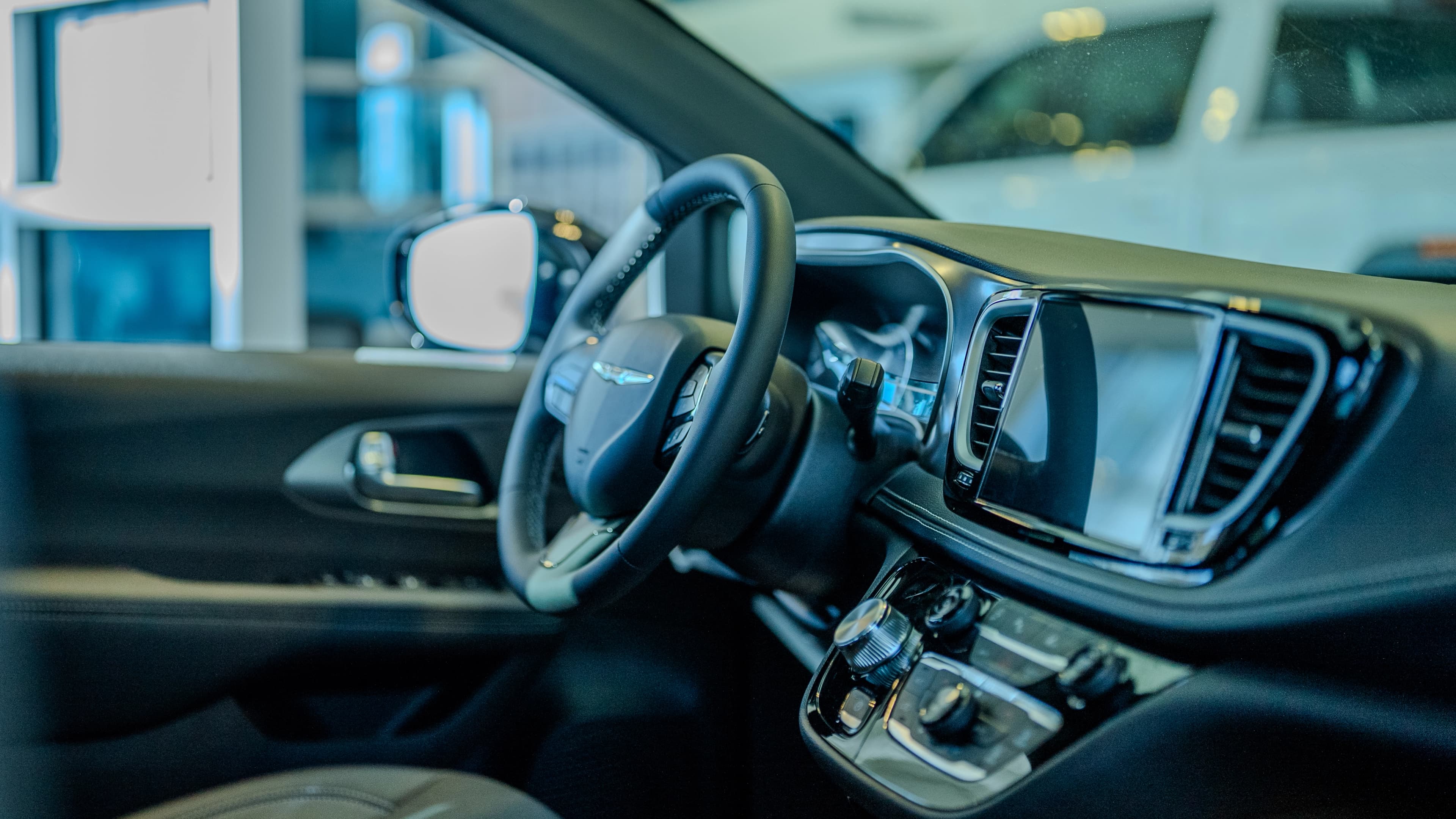
Modern showroom interiors are not optional — they are required by manufacturer image programs. Photo: Sweet Dreams US LLC
The Image Program: When Manufacturers Force a $2 Million Renovation
Every franchise has an 'image program' — facility design standards the dealer must meet, often at multi-million-dollar cost. Reading the image schedule before you buy a dealership is one of the highest-stakes diligence items in the deal.
When a buyer underwrites a dealership acquisition, the headlines are usually the obvious ones — sales volume, gross per unit, fixed-operations absorption, the value of the underlying real estate. The line item that quietly determines whether the deal works or breaks is harder to see on the income statement. It lives in a binder of OEM facility specifications, and it is called the image program.
Every franchise dealer in America operates under one. The image program is the manufacturer's master document for what a dealership has to look like — exterior architecture, signage, showroom finishes, customer lounge design, service drive layout, parts department configuration, the brand-specific elements that have proliferated as the industry has shifted toward EVs and connected vehicles. Compliance is not optional. The franchise agreement requires it, and the OEM enforces it.
When a manufacturer refreshes the image program — and they all do, on a roughly decade-long cycle — every dealer in the network receives the same letter. Renovate to the new standard within a defined window, or lose access to the levers that make the franchise profitable. For an acquirer who didn't see it coming, that letter can turn a clean acquisition into a multi-million-dollar capex problem inside the first 24 months of ownership.
The Brand Standards Behind Every Showroom
An image program is, at its most basic, a brand consistency tool. The OEM wants every consumer who walks into a Toyota store anywhere in the country — or a BMW store, or a GM store — to encounter a recognizably identical experience. Same exterior pylon, same showroom flooring, same lounge furniture aesthetic, same service write-up bays, same delivery area. The investment-grade reason brands enforce this is that consistency drives consumer trust, and consumer trust drives lifetime franchise value.
The specifics are remarkably granular. A typical image program runs hundreds of pages and dictates exterior wall materials, approved color palettes, signage dimensions and illumination, landscape requirements, customer parking configuration, the ratio of showroom square footage to vehicle inventory, the number and design of customer-facing F&I offices, the layout of the service drive, the brand of espresso machine in the customer lounge. EV-capable brands now layer in additional requirements — dedicated charging stations on the showroom floor, EV delivery bays, technician training facilities for high-voltage systems.
These standards are written into the franchise agreement as a facility obligation. The agreement itself, which we covered in the previous chapter, is the legal vehicle. The image program is the engineering specification that the agreement points to. Dealers who skip image compliance are not violating a suggestion — they are in default of a binding contract with the OEM.
The Renovation Cycle: Every 7 to 10 Years
Image programs are not static. Most manufacturers issue a major refresh every seven to ten years, with smaller updates layered in between. A refresh can be triggered by a global brand reset, a model lineup transition, the arrival of EV product, or simply the cumulative aging of the network. When the refresh hits, the OEM publishes a compliance window — typically three to five years — by which every dealer must complete the renovation.
When GM rolled out the Project ESSENCE image program around 2009, the consequences rippled through the network for the next decade. Dealers across Chevrolet, Buick, GMC, and Cadillac collectively spent billions of dollars renovating to the new standard. Stores that thought they were five years from a major capex project suddenly faced one. Stores that had recently rebuilt got the gift of a long compliance runway. The variance between those two positions, on otherwise identical dealerships, was worth millions of dollars in present value.
That cycle is the central fact every acquirer needs to internalize. A dealership is not a fixed-cost facility. It is a leased-from-the-OEM facility that must be re-capitalized on the manufacturer's clock. The store you buy today at year three of a ten-year cycle is a fundamentally different asset than the same store at year eight, even if the income statement looks identical.
What an Image Program Actually Costs
Costs vary widely by brand, by scope, and by the starting condition of the facility. A moderate refresh — new exterior facade, updated signage, refreshed showroom finishes, lounge upgrade, brand-correct paint and materials — typically lands in the $500,000 to $2 million range. A more comprehensive renovation that touches the service drive, parts department, and adds EV-capable infrastructure can run $2 million to $5 million. A ground-up rebuild for a luxury brand or a major facility expansion can easily exceed $5 million and reach $15 million or more for the largest stores in the most expensive markets.
Those numbers are the gross construction cost. They do not include the operational disruption — the lost showroom days during construction, the temporary service capacity reduction, the customer experience hit while a portion of the facility is under tarp. A well-run renovation phases the work to keep the store open, but even a phased renovation will dent gross by 5 to 15 percent over the construction window. That P&L impact has to be modeled into the project alongside the hard construction number.
The capex is real, but it is also predictable. An operator who knows the cycle can plan for it, finance it, and time it. An acquirer who walks into a store at year nine of a ten-year cycle without knowing what the next 24 months hold is the one who gets surprised — and surprises in this business are almost always expensive.
By the Numbers
Image Program Capex Reality
Moderate refresh (facade, signage, showroom finishes): $500K–$2M per store
Comprehensive renovation (showroom, service drive, EV infrastructure): $2M–$5M
Ground-up rebuild or luxury-brand reimage: $5M–$15M+
Typical refresh cycle: every 7–10 years per brand
Compliance window after refresh announcement: 3–5 years
Manufacturer subsidies typically offset 20–40% of total project cost
Manufacturer Subsidies and the True Net Cost
The headline image-program number is rarely the number the dealer actually pays. Most OEMs offer some form of facility assistance — direct facility allowances, per-vehicle credits earned against image compliance, low-interest construction financing through the captive lender, or rebates tied to hitting milestones. A common structure is a $200 to $500 credit per new vehicle sold, accumulated over the renovation period and paid out as the project completes.
Stack those programs together and a high-volume store can recover 20 to 40 percent of the gross construction cost over the life of the renovation. A $2 million project can net to $1.2 to $1.6 million. A $5 million project can net to $3 to $4 million. The subsidies do not eliminate the capex burden, but they materially change the underwriting math — and they reward dealers who plan the project carefully enough to maximize what is recoverable.
The catch is that subsidy programs come with their own rules. Allowances are typically capped, milestone payments are conditional on certified inspections, and per-vehicle credits accrue only while the dealer is in good standing on volume objectives. An operator who underperforms on sales during the renovation period can lose access to the very credits that were supposed to fund it. That is why image-program planning lives at the intersection of construction management and operational performance — they cannot be run in separate silos.
The Negotiation Game with the OEM
An image program looks rigid in the binder, but in practice there is meaningful room to negotiate. Dealers — and especially dealer groups with multiple rooftops — can often secure phased renovation timelines, materials substitutions that hit the spirit of the spec without the premium price tag, design exceptions for unusual sites, and additional subsidy beyond the published program. Saving $500,000 to $1 million off the listed cost is not unusual for a sophisticated operator who knows what to ask for and when.
Leverage in those negotiations comes from a few sources. Operating multiple stores for the same OEM creates a relationship the manufacturer wants to protect. Hitting volume and CSI objectives gives the dealer credibility when asking for accommodation. Coming to the table with a thoughtful alternate proposal — drawn by a qualified architect, costed by a real general contractor — is far more effective than asking for relief in the abstract. The OEM facility team is far more likely to grant exceptions to a dealer who has clearly engaged seriously with the program than one who is simply trying to spend less.
This is one of the operator competencies that separates a high-performing dealer group from a one-store operator. A solo dealer renovating once a decade has limited reps and limited leverage. A group running ten stores across multiple brands sees image programs constantly, has standing relationships with OEM facility teams, and has the in-house construction expertise to plan, scope, and value-engineer projects in a way that compounds savings across the platform.
Image Programs in Buy-Sell Diligence
When a target dealership comes to market, the question that has to be answered before anything else is settled is simple: where is this store in its image cycle? A facility that completed a full reimage 18 months ago is on a different planet from one that is sitting on a $2 million renovation invoice due in 24 months. The first deal can be priced at full multiple. The second deal needs a meaningful price adjustment, a seller credit, or an explicit reservation in the working capital build to fund the upcoming work.
Sellers do not always volunteer this information. The image obligation is sometimes buried in correspondence with the OEM facility team rather than written plainly into the dealer's financial statements. A standard purchase agreement should require the seller to deliver every piece of image-program correspondence from the manufacturer over the prior three years, plus the current compliance status and any pending notices. Anything less than full disclosure on this point is a diligence failure.
The right diligence sequence is to read the franchise agreement's facility provisions, pull the current image program specification from the OEM, walk the store with an architect or facility consultant who knows the brand, identify the gap between current condition and current spec, and price the gap at realistic local construction costs. The output is a number — the renovation liability the buyer is inheriting — and that number flows directly into the deal model. There is no faster way to overpay for a dealership than to skip this step.
Prime Insight
Coleman Prime evaluates image-program exposure on every acquisition before a letter of intent is signed.
The diligence process pulls current OEM facility specifications, walks the store with brand-experienced consultants, and prices the gap to local construction costs — so the renovation liability is in the deal model from day one, not discovered after close.
When a project is required, the team negotiates phasing, materials substitutions, and subsidy maximization to bring net cost down by 20 to 40 percent versus the published number.
That discipline is one of the reasons platform stores carry healthier capex profiles than the single-store operators they are acquired from.
Prime Dealer Equity Fund is a private equity vehicle co-investing with Coleman Automotive Group in the acquisition and optimization of automotive dealerships across the United States.
For qualified investor inquiries:
→ Contact our investor relations team