
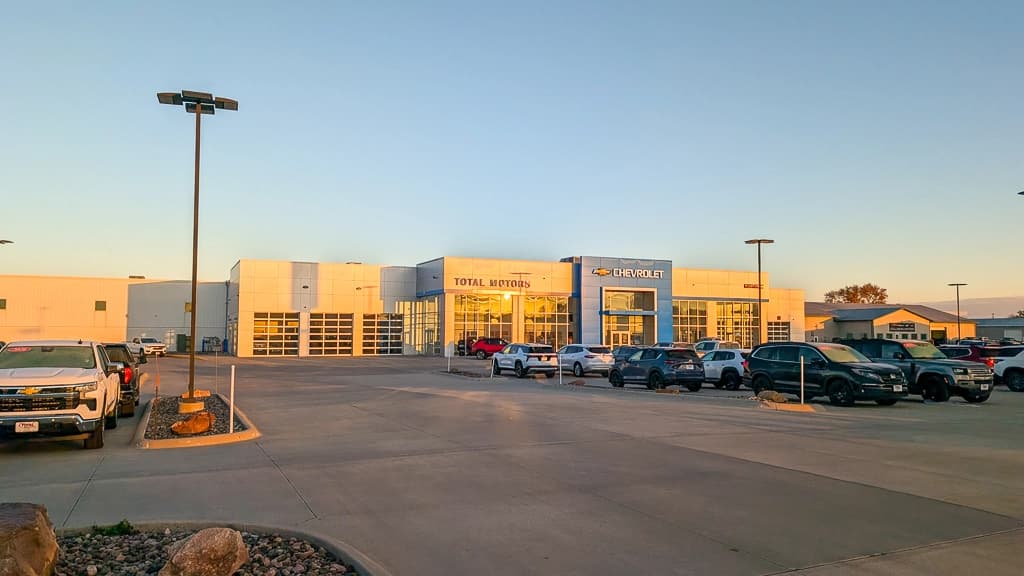
Le Mars Chevy GMC CDJR in rural Iowa. Lower overhead, deeper customer relationships, and geographic insulation from price competition create a margin profile that most metro stores cannot match. Photo: Sweet Dreams US LLC
Selling Cars in Small Towns: Why Rural Markets Outperform Where It Matters
The biggest dealerships are not always the most profitable. The most profitable dealerships are often the ones nobody outside the county has heard of.
When investors hear “car dealership,” most of them picture a sprawling metro auto mall — a high-traffic corridor lined with franchise flags, neon signage, and a sales floor competing against five other stores of the same brand within a twenty-mile radius. That is the mental model. And for evaluating an investment, that mental model is wrong.
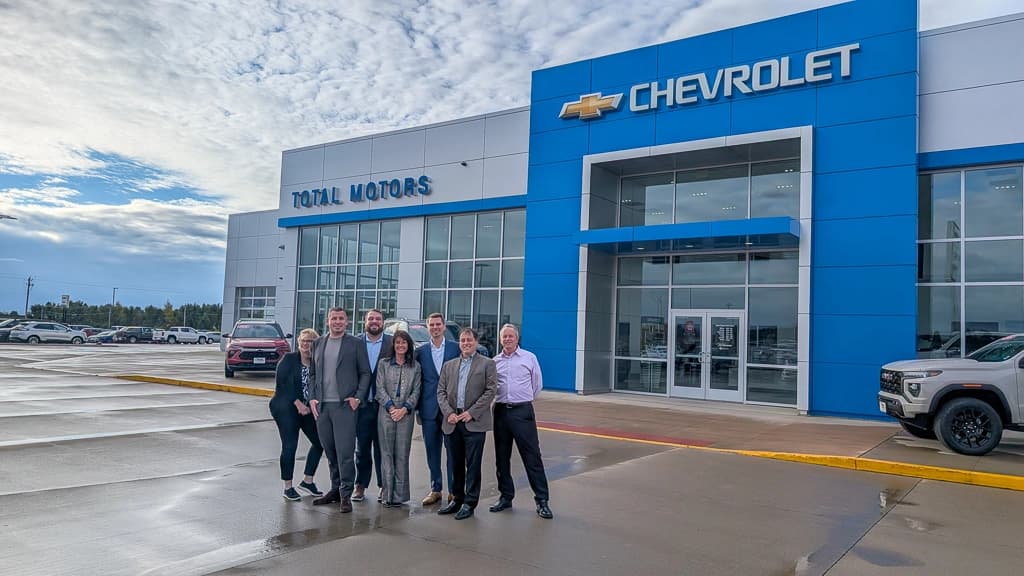
The stores in the Coleman Automotive portfolio are not located on metro auto rows. They are located in Warsaw, Indiana. Mt. Pleasant, Iowa and Le Mars, Iowa. Towns where the nearest same-brand competitor is 50 to 100 miles away. Towns where the dealership is a primary employer, a community institution, and the only qualified service provider for an entire region.
These are not consolation prizes. These are the most defensible, highest-margin dealership investments available in the market today. And the economics that make them so are structural — not circumstantial.
In the first post in this series, we explained why automotive dealerships are a compelling asset class. This post explains why the specific type of dealership we acquire — the rural, underperforming, geographically insulated store — produces the margin profile that support the Fund’s investment strategy.
The Geographic Moat
The single most valuable characteristic of a rural dealership is its geographic isolation.
In a metropolitan market, a consumer shopping for a new Ford has five or six dealerships within a thirty-minute drive. The product is identical at every location — same vehicle, same manufacturer warranty, same financing programs. The only differentiator is price. This forces metro dealers into a destructive race to the bottom where front-end margins are compressed to near zero, and profitability depends entirely on manufacturer volume bonuses and back-end F&I products. The consumer has all the leverage because the competition is a fifteen-minute drive away.
In a rural market, the dynamics invert completely. The nearest same-brand competitor may be fifty, seventy-five, or a hundred miles away. The consumer is not choosing between five dealerships offering the same product at different prices. They are choosing between driving to their local dealership — where they know the staff, where their family has bought vehicles for years, where the service department is fifteen minutes away — or making a three-hour round trip to save a few hundred dollars at a store where nobody knows their name.
That geographic distance creates a natural barrier to entry that functions identically to a franchise moat in any other industry. The dealership does not need to outspend the competition on digital advertising. It does not need to discount below cost to win the deal. The convenience premium, the relationship capital, and the proximity of the service department do the work that a metro store has to buy with marketing dollars.
State franchise laws reinforce this moat further. Relevant Market Area statutes prevent manufacturers from placing another same-brand dealership too close to an existing franchise point. In rural markets, where franchise points are already scarce, these protections create a territorial monopoly that no amount of capital can breach. The rural dealership is not competing for market share. It owns the market.
The Math That Metro Stores Cannot Replicate
The margin advantage of rural markets is not anecdotal. It is visible across every line item on the financial statement.
Start with overhead. Real estate — typically the largest fixed cost for any dealership — is dramatically cheaper in rural markets. A dealership footprint that costs $50,000 to $100,000 per month in a metro area can be had for under $10,000 in a rural county. That is not a marginal difference. It is a structural advantage that drops directly to the bottom line every single month, in every economic condition.
Advertising follows the same pattern. A metro dealership competing for digital leads against five same-brand competitors in a saturated market will spend $250 or more per unit sold on customer acquisition. A rural dealership operating with minimal local competition can achieve effective customer acquisition costs below $100 per unit — and much of that spend goes into analog channels that produce higher engagement at a fraction of the digital cost.
The result is a net profit margin that metro stores struggle to approach. Where a high-volume metro dealership may operate on net margins of 2% to 5%, a well-run rural store routinely operates at 8% to 15%. The rural store sells fewer units — but it keeps more of every dollar it generates. Volume is vanity. Margin is sanity.
The fixed operations advantage is even more pronounced in rural markets. When the dealership is the only certified service provider within a fifty-mile radius, the customer retention math changes fundamentally. Metro dealerships lose roughly 78% of their service customers within five years as consumers defect to independent shops, quick-lube chains, and competing franchise service departments. Rural dealerships retain a dramatically higher percentage — not because of superior marketing, but because there is nowhere else to go. The captive demand for certified maintenance drives absorption rates that most metro stores can only theorize about.
By the Numbers
Rural vs. Metro — The Margin Inversion
Real estate cost: Rural under $10K/month vs. Metro $50K–$100K/month
Customer acquisition cost: Rural under $100/unit vs. Metro $250+/unit
Net profit margin: Rural 8–15% vs. Metro 2–5%
First-year service retention: Rural 88% vs. Metro 65%
Five-year service retention: Rural 55% vs. Metro 22%
The Analog Arbitrage
One of the most counterintuitive operational advantages in rural markets is the channel through which customers are acquired. In a world where every metro dealership is competing for the same Google search results, the same Facebook retargeting audiences, and the same programmatic display inventory — driving digital costs higher every quarter — rural markets offer a completely different acquisition channel that metro stores have long abandoned.
Direct mail.
In a rural community, a personalized letter from the dealership — handwritten-style, addressed to the customer by name, referencing their vehicle or their service history — is not junk mail. It is a personal communication from a business they know, sent by people they have met, about a product they will eventually need. The engagement rate on physical mail in rural markets is not comparable to metro markets. It is categorically different. Customers call the store to thank the owner for the letter. That does not happen in Dallas.
The cost-to-impact ratio of this analog channel is extraordinary. A targeted direct mail campaign in a rural market produces conversion rates that would be considered exceptional for any digital channel — at a fraction of the cost per lead. When layered with cellular marketing tools and localized digital follow-up, the combined acquisition strategy operates at a customer acquisition cost that metro dealers spending six figures on digital cannot approach.
This is analog arbitrage: exploiting the price and efficiency gap between traditional outreach channels and the oversaturated, overpriced digital channels that metro dealers are forced to use because they have no alternative. In a market where the population is not bombarded by digital noise, the physical mailbox commands a premium, undivided share of consumer attention.
The arbitrage extends beyond mail. Local sponsorships — the county fair, the high school football team, the community fundraiser — generate brand equity in rural markets at a cost-to-impact ratio that no metro stadium sponsorship or broadcast campaign can match. The dealership is not advertising to the community. It is part of the community. And that social integration converts into customer loyalty that compounds over generations, not campaigns.
From the Floor
“We had a customer drive ninety minutes past two other franchise stores to buy from us — because he got a letter in the mail, he called the store, and the person who answered knew his name and what he was driving. That does not happen in a metro market. In a small town, the relationship is the product.”
— Kyle Coleman, CEO
→ See how Coleman acquires these storesThe Generational Loyalty Effect
In a metropolitan market, customer loyalty is measured in transactions. A consumer buys a vehicle, services it for a year or two, and then defects — to a competing dealership offering a better promotion, to an independent shop offering a lower price, or to a different brand entirely. The metro dealer is constantly refilling a leaky bucket, spending heavily on acquisition just to maintain market share.
In a rural market, loyalty is measured in generations. A family that buys from the local Ford dealer does not buy from the local Ford dealer once. They buy for decades. Their children buy from the same store. Their neighbors buy from the same store. The relationship between the customer and the dealership is reinforced by social proximity — they attend the same churches, their kids play on the same teams, they see each other at the grocery store.
This generational loyalty effect has profound financial implications. The customer lifetime value of a rural customer is structurally higher than a metro customer — not because the individual transactions are larger, but because the relationship lasts longer, the defection rate is lower, and the service revenue compounds over a far greater number of years. A customer who services their vehicle at the dealership for fifteen years generates dramatically more lifetime profit than a customer who defects after two.
The F&I penetration rates follow the same pattern. In a metro store, the F&I office is often an adversarial interaction — the customer has researched every product online, knows the margin structure, and negotiates aggressively. In a rural store, the customer is far more likely to accept a recommendation from someone they trust. Protection plans, service contracts, and gap insurance are not sold through pressure. They are accepted through relationship. The per-vehicle F&I profit in a trust-based rural transaction is meaningfully higher than in a price-based metro transaction.
Why We Target These Stores
The generational transfer crisis that is reshaping the dealership landscape is disproportionately concentrated in rural markets. The aging dealer principals who lack succession plans are overwhelmingly running single-rooftop stores in small towns. Their children have moved to cities. Their management teams are aging alongside them. The stores are stable but underoptimized — generating enough profit to fund a comfortable retirement but nowhere near their operational ceiling.
These are the stores Coleman Automotive targets. Not because they are cheap — though they are acquired at significantly lower multiples than metro stores — but because the combination of geographic moat, captive service demand, low overhead, and community integration creates a margin profile that responds explosively to operational optimization.
When the 90-day turnaround injects elite leadership, restructures the vendor stack, professionalizes the F&I process, and pushes fixed operations toward high absorption — all on a cost base that is a fraction of what a metro store carries — the resulting EBITDA improvement is outsized relative to the capital deployed. The rural store does not need to sell 500 units a month to be wildly profitable. It needs to sell 75 units a month at full margin with a service department that covers the overhead. The math is cleaner, the execution risk is lower, and the downside is structurally protected by the geographic moat that no competitor can breach.
Prime Insight
Prime Dealer Equity Fund targets rural and exurban dealerships specifically because the margin profile of these stores — driven by geographic insulation, low overhead, and captive service demand — produces superior risk-adjusted returns on deployed capital compared to high-volume metro stores operating on razor-thin margins.
The Investment Thesis, Restated
The conventional wisdom says that bigger is better. That volume is the measure of success. That the dealership on the metro auto row selling 500 units a month is the superior investment.
The data says otherwise. The dealership in the small town — the one with the geographic moat, the $8,000 monthly rent, the 88% first-year service retention, the generational customer base, and the direct-mail campaign that produces phone calls from grateful customers — is the store that generates the margin. It is the store where the retained earnings accumulate fastest. It is the store that funds the flywheel.
The Road to 40 is not built on acquiring trophy stores in competitive metro markets. It is built on acquiring underoptimized stores in defensible rural markets and applying an operational playbook that unlocks the profit sitting dormant under the surface. Every store in this portfolio was chosen because the fundamentals — not the headlines — support the investment.
Prime Dealer Equity Fund is a private equity vehicle co-investing with Coleman Automotive Group in the acquisition and optimization of automotive dealerships across the United States.
For qualified investor inquiries:
→ Contact our investor relations team